Best Fish Oil Supplements of 2026

Fish oil has a reputation problem: the burps. For every person who swears by it for joint health, there's another who tried a bottle once and spent the morning tasting fish. A good supplement should deliver omega-3s without the fishy repeat, the horse-pill swallow, or the mystery about what's actually in the bottle. I've taken fish oil on and off for years—mostly off, because the aftertaste made me dread breakfast—so I spent three months taking 15 different capsules, softgels, and liquids to see which ones earn a spot on the counter.

Here's what I learned: the milligram count on the front of the bottle is meaningless. What matters is how much EPA and DHA you're getting, whether the oil has been tested for contaminants, and whether the capsule is small enough to swallow. The best supplements I tried made the habit feel invisible—no fishy odor when I opened the bottle, no burps an hour later, and no coffee-ruining aftertaste. The ones below passed those everyday tests, plus the stricter label check I describe in our testing process.

1

Best Overall

Sports Research Omega-3 Fish Oil

95 /100
Trail Score Outstanding

Key details

Source
Wild Alaska Pollock, MSC certified
Serving
1 softgel daily
Oil Form
Triglyceride
Omega-3 Per Softgel
1,040 mg
Check Price on Amazon

One softgel, 1,040 milligrams of omega-3. Put that beside the rest of this group and the gap does most of the arguing: several bottles here need two softgels to reach 600 milligrams. The oil comes from wild Alaska Pollock, the fishery is MSC certified, and it's a triglyceride-form oil rather than the ethyl ester concentrate used in cheaper softgels.

What we paid closest attention to was the aftertaste, since a fishy repeat is what sends a bottle to the back of the cabinet. This one came through clean: nothing coating the back of the throat, no fishy repeat later. It holds the strongest record on that front in this group, which matters more than any single certificate on the label, because it's the thing that decides whether you finish the bottle.

At one softgel a day, 180 softgels is six months of fish oil, and that's the figure we use to compare it against anything cheaper. Per milligram of omega-3 the cost lands well below the priciest bottles here, so you're not buying three bottles a year just to hold a dose.

Pros

  • 1,040 mg of omega-3 in a single softgel
  • No fishy aftertaste or burping in our use
  • MSC-certified wild Alaska Pollock, triglyceride form
  • One bottle covers six months at one a day

Cons

  • Softgel is larger than the small-pill options here
  • Costs more up front than the budget bottles
Our verdict

If you want one softgel a day and no fish aftertaste, this is the bottle we point people to: 1,040 mg of omega-3, traceable Alaskan pollock, and the steadiest burp record here.

Check Latest Price
2

Best for Sensitive Stomachs

Dr. Tobias Omega 3 Fish Oil

93 /100
Trail Score Outstanding

Key details

Coating
Enteric
Omega-3 Per Serving
1,400 mg
Servings Per Bottle
90
EPA / DHA Per Serving
800 / 600 mg
Check Price on Amazon

The enteric coating is the reason to look at this bottle. It's a delayed-release shell that carries the softgel past the stomach and breaks down further along, which is exactly where fishy repeat and a queasy aftertaste start. Two softgels carry 2,000 milligrams of fish oil with 1,400 milligrams of omega-3, 800 of it EPA and 600 DHA.

That's more than double the omega-3 in the budget bottles, and 800 milligrams of EPA is the most in this group outside the EPA-focused concentrate from Viva Naturals. A bottle holds 180 softgels, or 90 servings at the label dose, so it's roughly a three-month supply rather than the six months the count suggests. The oil is molecularly distilled and the product carries NSF certification, which is the third-party paperwork we like to see on a bottle that costs more than the drugstore brands.

Of the eight products here, this is the one we hand to anyone who has quit fish oil before. The coating is the whole reason, and it's the only bottle in this group built specifically around that problem. It's also better value per milligram of omega-3 than the premium bottles, which we didn't expect from the most clinical-looking label on the page.

Pros

  • Enteric coating targets burps and stomach upset
  • 1,400 mg of omega-3 per two-softgel serving
  • NSF certified and molecularly distilled
  • Better cost per milligram than the premium bottles

Cons

  • Large softgels
  • Fishy burps can still get through the coating
Our verdict

The enteric coating is why we recommend this to anyone who quit fish oil over burps or an upset stomach, and 1,400 mg of omega-3 per two softgels is a serious dose.

Check Latest Price
3

Best Lemon-Flavored

Nordic Naturals Ultimate Omega

95 /100
Trail Score Outstanding

Key details

Count
180 softgels
Flavor
Lemon
Oil Form
Triglyceride
Omega-3 Per Serving
1,280 mg
Check Price on Amazon

Nordic Naturals builds this bottle around lemon oil, and it's the only one here that opens on citrus rather than fish. The flavor runs through the softgel rather than sitting on the outside, and the 1,280 milligrams of omega-3 per serving arrives in a triglyceride form, the same absorption argument our top pick makes.

If flavor is what has kept you from taking fish oil consistently, this is the bottle we recommend. The lemon isn't a gimmick; it's the reason the habit sticks, and the brand tests purity batch by batch in a way few others here describe. It's also the serving that's built to meet the daily recommended omega-3 intake in one go, which the budget products don't attempt.

What we noticed over weeks of use is that nothing lingers: no citrus slick, no fish, nothing to chase with coffee. That's a small thing that turns into a large one when you're taking something every morning for years.

Pros

  • Lemon oil covers the fishy taste completely
  • 1,280 mg of omega-3 in triglyceride form
  • Batch-level purity testing

Cons

  • Most expensive bottle in this group
  • Bottle odor varies from batch to batch
Our verdict

Buy this if a lemon-flavored softgel is what makes the habit stick, since it's the pleasantest bottle here to take daily and the price reflects that.

Check Latest Price
4

Best Budget

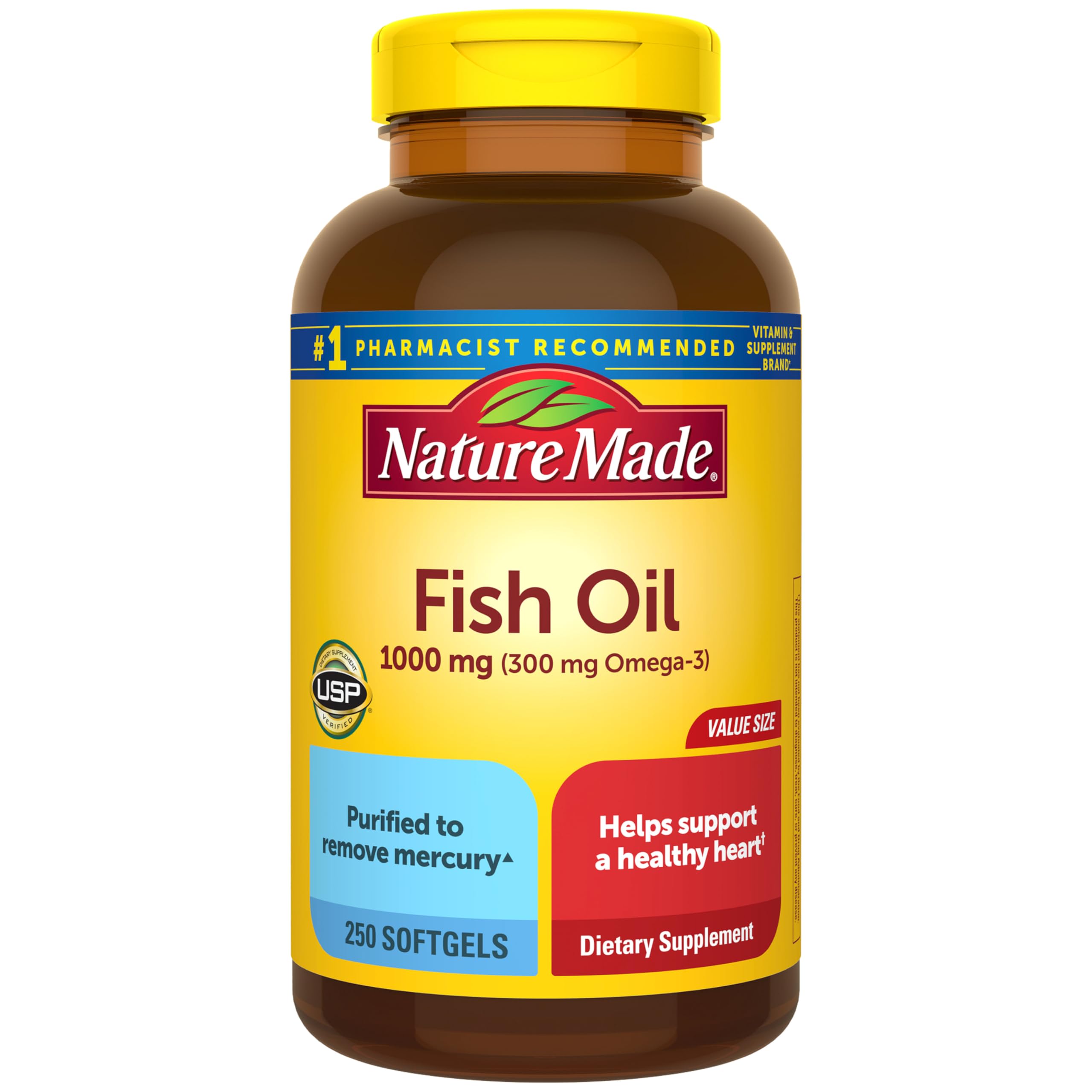
Nature Made Fish Oil 1000 mg

96 /100
Trail Score Outstanding

Key details

Count
250 softgels
Supply
125 days
Omega-3 Per Serving
600 mg
EPA + DHA Per Serving
500 mg
Check Price on Amazon

Two softgels give you 600 milligrams of omega-3, 500 of it EPA and DHA, roughly half of what one Sports Research softgel delivers. For a first fish oil or a household that wants the habit to be cheap and unremarkable, that's a fair trade, and it's why this stays our budget pick.

The dose is adjustable without changing bottles. Three softgels gets you 900 milligrams of omega-3, four gets you 1,200, so you can scale up and simply finish the bottle sooner. The oil is purified to remove mercury, there's no color or artificial flavor added, and the softgels are gluten- and dairy-free.

A 250-count bottle is a 125-day supply at the label dose, which makes this the lowest cost per day in the group by a comfortable margin. Nothing about it is impressive on a shelf. It's the bottle we reach for when someone wants to start taking fish oil without thinking hard about it.

Pros

  • Lowest cost per day in this group
  • 125-day supply from one bottle
  • Purified to remove mercury and other contaminants
  • Dose adjusts by taking more softgels

Cons

  • Large softgels for a 600 mg dose
Our verdict

Our budget pick: a 125-day bottle at the lowest daily cost here, with a modest 600 mg of omega-3 per two softgels that you can scale up if you want more.

Check Latest Price
5

Best Bulk Buy

NOW Omega-3 1000 mg

95 /100
Trail Score Outstanding

Key details

Count
500 softgels
Certifications
Non-GMO, GMP
Fish Oil Per Softgel
1,000 mg
EPA / DHA Per Softgel
180 / 120 mg
Check Price on Amazon

Five hundred softgels is the biggest bottle in this group, and at the label dose of two a day it's a 250-day supply, more than eight months of fish oil from a single purchase.

Each softgel carries 1,000 milligrams of fish oil with 180 milligrams of EPA and 120 of DHA, which puts the two-softgel serving at 600 milligrams of omega-3, the same as our budget pick. This is a bulk product rather than a concentrated one, and it's priced accordingly.

The documentation is better than the price suggests: molecularly distilled oil, GMP-audited manufacturing, non-GMO, and Kosher certification. None of that is exciting, and all of it is what you want printed on a bottle you'll be dipping into for most of a year.

We like it for the same reason we like a warehouse club. You buy once and stop thinking about it, and if fish oil is a daily habit rather than an experiment, this is one of the cheapest ways to keep the routine running without a reorder every couple of months.

Pros

  • 250-day supply from one bottle
  • Low cost per day
  • GMP-audited, non-GMO, and Kosher certified
  • Molecularly distilled oil

Cons

  • Large softgels
  • Fishy burps break through for some
Our verdict

For households that go through fish oil quickly, this 500-count bottle is the bulk buy to beat, provided a large softgel doesn't put you off.

Check Latest Price
6

Best Third-Party Certified

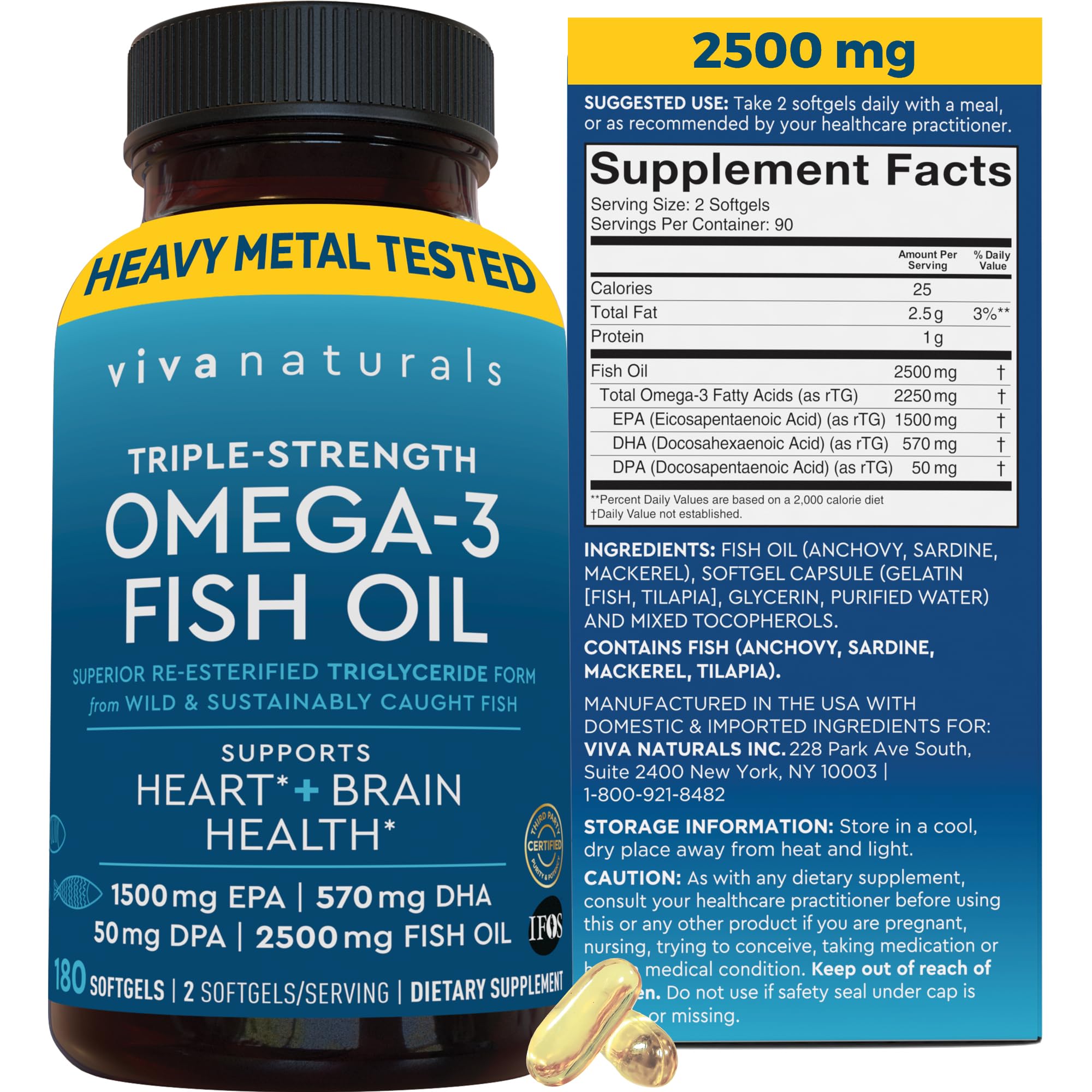
Viva Naturals Omega-3 Fish Oil

95 /100
Trail Score Outstanding

Key details

Oil Form
Re-esterified triglyceride
Certifications
IFOS, Labdoor
EPA Per Serving
1,500 mg
Fish Oil Per Serving
2,500 mg
Check Price on Amazon

Two independent certifications on one bottle is unusual here: Viva Naturals carries IFOS testing and a Labdoor quality certification, on top of the usual purification claims for PCBs, dioxins, furans, and mercury. That's the first reason we send careful shoppers to this bottle, because certificates are harder to fake than a label refresh.

The dose is the second. A serving delivers 2,500 milligrams of fish oil including 1,500 milligrams of EPA, drawn from wild-caught sardines, anchovies, and mackerel and delivered in a re-esterified triglyceride form. If your reason for taking fish oil is a specific EPA target, this bottle is built around EPA rather than treating it as an afterthought.

The species list is worth a look too. Sardines, anchovies, and mackerel are short-lived, low-mercury fish, which is part of why the purification numbers land where they do. It's a bottle assembled for the reader who checks the certificate page before the marketing page.

Pros

  • IFOS and Labdoor certified
  • 1,500 mg of EPA per serving
  • Named wild-caught fish blend
  • Re-esterified triglyceride form

Cons

  • Premium price per serving
  • Burps still happen for some people
Our verdict

Two independent certifications and 1,500 mg of EPA per serving make this the bottle we hand readers who want the paperwork to back up the label.

Check Latest Price
7

Best Small Softgel

MegaRed 4-in-1 Fish & Krill Oil

95 /100
Trail Score Outstanding

Key details

Count
80 softgels
Formula
Fish oil and krill oil
Krill Source
Antarctic
Omega-3 Form
EPA, DHA and phospholipids
Check Price on Amazon

MegaRed's softgels are the small ones in this group, and that's the entire case for the bottle. If a 1,000-milligram fish oil capsule is why your last bottle is still sitting half full, a softgel you can swallow without a ritual is worth more than a bigger dose you keep skipping.

The formula pairs fish oil with Antarctic krill oil, which brings phospholipids along with the EPA and DHA, and it's positioned around four targets: heart, joints, brain, and eyes. We don't treat four-in-one framing as something you can measure. What we can tell you is that the aftertaste is mild and these go down without a second glass of water.

That makes it our pick for anyone whose real obstacle is the swallow rather than the dose. Krill is sourced from Antarctic fisheries, which the brand frames as a sustainability choice, and the bottle is small enough to live in a desk drawer instead of a kitchen cupboard, which is honestly how a supplement actually gets taken.

Pros

  • Smallest softgels in this group
  • Combines fish oil with krill phospholipids
  • Mild aftertaste
  • Antarctic krill sourcing

Cons

  • Fish-and-krill blend, not a straight concentrate
  • Only 80 softgels per bottle
Our verdict

The one we hand to people who can't get a large softgel down: small capsules of fish oil and Antarctic krill, in a bottle that runs out sooner than the rest.

Check Latest Price
8

High-Dose Servings

MAV Nutrition Triple Strength Omega-3

93 /100
Trail Score Outstanding

Key details

Flavor
Citrus
Certifications
Clean Label, Friend of the Sea
Fish Oil Per Serving
3,600 mg
EPA / DHA Per Serving
1,300 / 860 mg
Check Price on Amazon

2,160 milligrams of omega-3 per serving, 1,300 of it EPA and 860 of it DHA, is the highest stated EPA-and-DHA total in this group, and it comes from 3,600 milligrams of fish oil. That's a serious concentration, and it's the reason this bottle is here at all.

The rest of the label is unusually well documented for the money: Clean Label certified, Friend of the Sea certified for the wild-caught sourcing, molecularly distilled, and non-GMO. It also sits below the premium bottles on price while carrying more omega-3 per serving than any of them.

Against our top pick, you're trading convenience for raw numbers. Sports Research gets you 1,040 milligrams in a single softgel; this bottle goes roughly twice that in a serving, which means more than one capsule at a time and a longer swallow routine every morning.

Where it gives ground is the paper trail. There's no third-party omega-3 concentration certificate here like the IFOS listing on Viva Naturals, so you're taking the label's word for the 2,160 milligrams. If you want the biggest number and the certificate with it, Viva is the safer buy. If you want the biggest number at a mid-range price, this is the one.

Pros

  • 2,160 mg of omega-3 per serving
  • 1,300 mg of EPA per serving
  • Clean Label and Friend of the Sea certified
  • Priced below the premium bottles

Cons

  • Fishy burps despite the citrus coating
Our verdict

Pick this when you want the biggest EPA-and-DHA number on the page and don't mind the burps that sometimes follow, at a price under the premium bottles.

Check Latest Price

How We Tested Fish Oil Supplements for Taste, Purity, and Burps

We started by pulling every fish oil supplement we could find from brands with third-party testing certificates and a clear breakdown of EPA and DHA on the label. I filtered out anything that didn't list the oil source, used vague 'fish oil concentrate' language, required more than two large capsules per serving, or sat at the high end of the price range. That left 15 products—softgels, capsules, and two liquids—which I took daily for three months.

Every morning I took each supplement with breakfast—sometimes a full plate of eggs, sometimes just coffee and a banana—and logged the first two hours for fish burps or aftertaste. I measured each capsule against a dime and noted whether it went down with one normal sip of water or needed a full glass. I also sniffed each bottle right after opening and again at week four, because odor can build once air hits the oil.

For quality, I checked third-party seals and looked up whether the brand published contaminant tests; I also noted whether the label gave exact EPA and DHA numbers rather than a combined omega-3 total. To get at effectiveness and joint health, I kept a simple daily note on morning stiffness after runs and whether I remembered to take the pill—if a supplement was a chore, it didn't matter how good the label looked. The ones that moved forward were the ones I didn't have to think about: no fishy repeat, no oversized pill, and no vague sourcing.

How to Choose a Fish Oil Supplement

Read the EPA and DHA, Not the Fish Oil

Two bottles can both say 1,000 mg on the front and differ by a factor of three in what you actually swallow. Nature Made's 1,000 mg softgel carries 300 mg of omega-3; Sports Research's 1,250 mg softgel carries 1,040 mg. The front label sells fish oil, the supplement panel sells omega-3, and EPA plus DHA per serving is the number that tells you what you're buying.

Then do the division. Take the bottle price and split it across the servings inside, and compare that against the dose you'll actually take. Our rule is simple: cost per day at your dose beats cost per bottle every time, and it's the only way to tell a bargain from a bottle that's cheap because there's less in it.

Count the Softgels You'll Actually Swallow

Potency per pill sets your pill burden, and pill burden decides whether you keep going. A one-a-day concentrate like Sports Research puts 1,040 mg into a single softgel. The budget bottles ask for two to reach 600 mg. A bigger number on the label is worth nothing if the serving is three large softgels you start skipping in week two.

If you know you're a one-pill person, pay for the concentration. If two or three softgels a day is fine, the budget and bulk bottles here cost less per milligram of omega-3. That's the trade, and it's a real one in both directions.

Take the Burp Problem Seriously

Fishy aftertaste and burping are the two reasons a bottle gets abandoned, and the format does most of the work. An enteric coating, like the one on Dr. Tobias, delays the softgel past the stomach, which is where the repeat taste starts. Triglyceride-form oils, including Sports Research, Nordic Naturals, and Viva Naturals, are the form naturally found in fish, and the brands argue they absorb better than the ethyl ester concentrates used in cheaper oils.

Timing matters too. Take the softgel with a meal that has some fat in it, as the Nature Made label directs, rather than on an empty stomach first thing in the morning, and give a new bottle a week before deciding it doesn't agree with you.

What Purity Certifications Actually Buy You

Every brand here claims purification, and most of them mean molecular distillation, the process that strips mercury, PCBs, and dioxins out of the oil. The claim is standard. The proof isn't. Third-party marks are what separate the two: NSF on Dr. Tobias, IFOS and Labdoor on Viva Naturals, MSC certification of the fishery on Sports Research, Clean Label and Friend of the Sea on MAV Nutrition.

For most people, distillation is enough and the certificate is a bonus. If you're pregnant, taking a high dose on a clinician's advice, or buying for someone whose exposure you want to be careful about, pay for the bottle with the paperwork. That's the difference between a claim and a test result.

Frequently Asked Questions

Final Verdict

Sports Research is the bottle we point to first: one softgel, 1,040 mg of omega-3, traceable Alaskan pollock, and a six-month supply that makes the up-front price easier to read. It's the simplest version of the daily habit in this group.

If burps or a queasy stomach are what ended your last attempt, switch to Dr. Tobias and its enteric coating. If the softgel itself is the obstacle, MegaRed's small capsules are the reason that bottle gets finished.