Best Fiber Supplements for Kids with Constipation of 2026

A constipated kid is a miserable kid, and the fix is rarely as easy as pouring a glass of prune juice. Children will try something once and then refuse it forever if the texture is off or the flavor lingers, which is why so many fiber powders end up forgotten at the back of the pantry. What a good supplement actually fixes is the standoff: it disappears into a drink or a snack, works quietly over a day or two, and never turns breakfast into a negotiation.

Over the past four months, my team and I worked through 14 of them — flavorless powders, fruit gummies, soft chews — mixed into water, milk, applesauce, and yogurt at breakfast, after school, and at bedtime. The pattern was consistent: taste and texture decide whether a kid takes it a second time, while dissolvability and ingredients decide whether it actually helps. A gritty powder that clumps at the bottom of the cup is a lost cause. The picks below cleared both bars.

1

Best Overall

Culturelle Kids Probiotic + Fiber Packets

95 /100
Trail Score Outstanding

Key details

Form
Unflavored powder packet
Count
60 packets
Age Range
1 year and up
Fiber Per Packet
0.12 oz
Check Price on Amazon

Culturelle's packet says to stir it into food, yogurt or applesauce or a spoonful of oatmeal, and warns against anything hot. The instinct is to mix it into a cup of milk instead, and that is exactly where the clumping starts. In food the powder disappears; in a cold drink it can leave a gritty layer behind. The label is doing you a favor, and it is the instruction most parents skip.

Three and a half grams of fiber per packet, 2.5 billion CFU of LGG, and a dose that runs from one packet to three a day. That last part is why this is our default. Constipation is managed by finding the amount that produces a comfortable, regular stool and staying there, and a gummy locks you into its serving while a packet lets you move up one step at a time. The label starts at age 1, so the same box covers a toddler and a second grader.

Sixty packets to a box, sugar-free and gluten-free, and slim enough to tuck a few into a diaper bag for a weekend away. At the full three-packet dose a box empties in under three weeks, so buy two once you have settled on a dose rather than discovering it mid-week.

The one thing instructions cannot fix is a child who will not eat yogurt, applesauce, or anything else off a spoon. For that kid, the HyFiber liquid is the better answer: a fraction of the volume, and nothing to swallow but a tablespoon.

Pros

  • 3.5 grams of fiber printed on every packet
  • Dose adjusts from one packet to three daily
  • Labeled for ages 1 and up
  • Unflavored and mixes into yogurt or applesauce

Cons

  • Costs more than any gummy in this set
Our verdict

Our default pick: a printed 3.5-gram fiber dose you can raise from one packet to three, and a label that starts at age 1.
Check Latest Price
2

Best for Toddlers

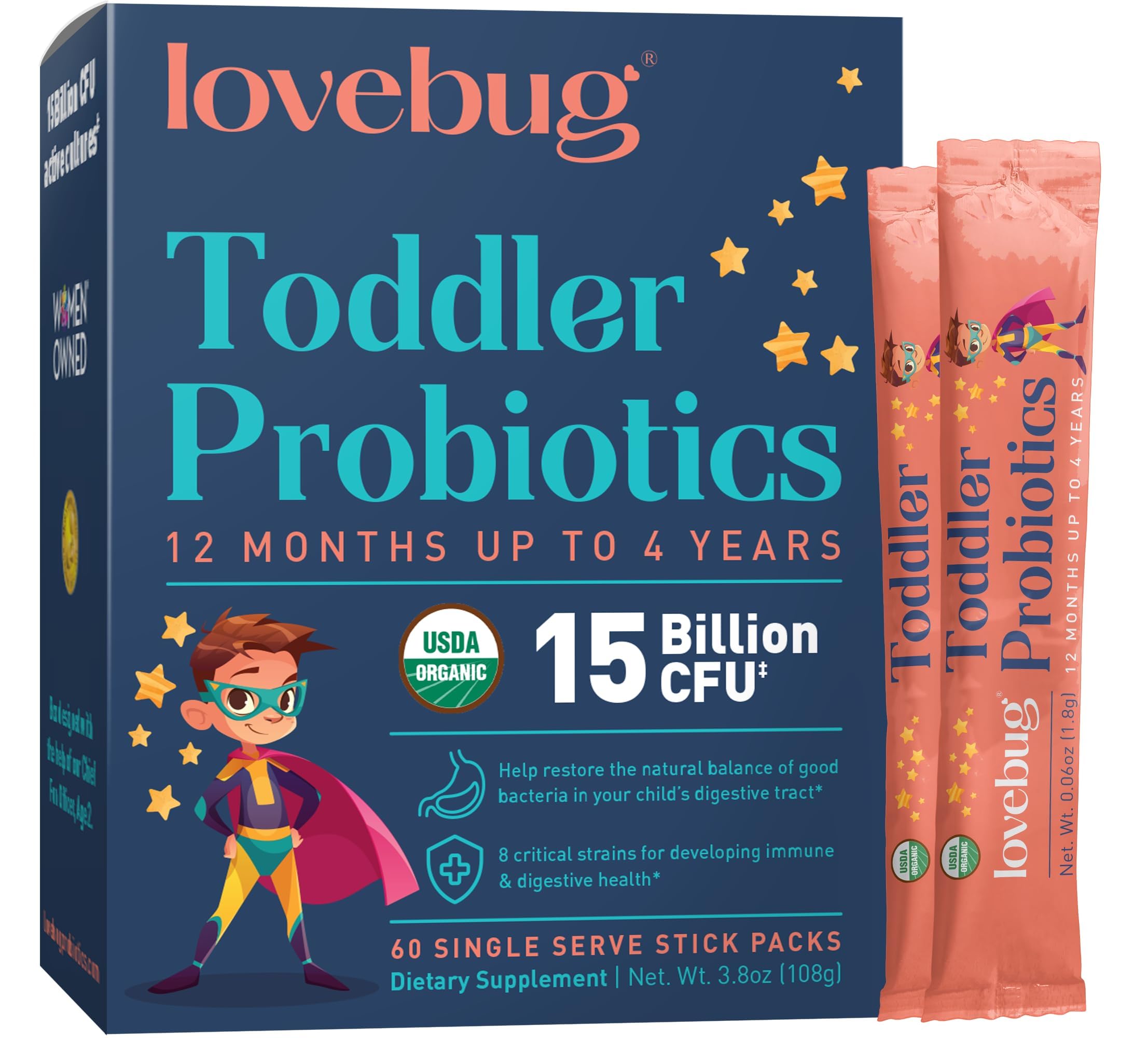
Lovebug Toddler Probiotics with Fiber

93 /100
Trail Score Outstanding

Key details

Count
60 stick packs
Age Range
1 to 4 years
Fiber Source
Organic agave inulin
Probiotic Strength
15 billion CFU
Check Price on Amazon

Flavorless is a big claim on a kids' supplement, and Lovebug comes closer to earning it than anything else here. A stick pack disappears into yogurt, applesauce, or milk without turning it gritty, which is the whole reason this one sits near the top for ages 1 to 4: a toddler who inspects every spoon will not find it. Inside is 15 billion CFU across eight strains, including LGG and B. infantis, plus organic agave inulin carrying the fiber side.

Pre-portioned stick packs mean nothing to measure before coffee and nothing to spill in a lunchbox, and the powder goes into cool or room-temperature food rather than a hot bottle. The age range is the real boundary: this is built for 1 through 4, so a five-year-old has moved past the label and needs a different pick from this list.

A box of 60 covers two months at one a day, and the individual packets travel better than a tub of powder, so you can count out a week and leave the rest home. It is the priciest thing here, which gets easier to accept once the alternative is a daily standoff over a spoon.

Pros

  • Flavorless in yogurt, applesauce, and milk
  • 15 billion CFU across eight strains
  • Pre-measured stick packs, nothing to scoop
  • Labeled for ages 1 to 4

Cons

  • Fiber content is not stated in grams
Our verdict

If your toddler inspects every spoon, this is the one we reach for: flavorless, pre-measured, and built for ages 1 to 4.

Check Latest Price
3

Best Budget

Lil Critters Kids Fiber Gummies

95 /100
Trail Score Outstanding

Key details

Flavors
Lemon, raspberry, strawberry
Added Sugar
None added
Fiber Per Serving
0.11 oz
Check Price on Amazon

Three grams of fiber per serving, three flavors in the bottle, lemon and raspberry and strawberry, no added sugar, and the lowest price of anything in this set. For a kid who already expects a gummy bear with breakfast, that combination is hard to argue with.

The chew is firm, closer to a wine gum than a soft candy bear, and that texture is the fork in the road. Children who like a chewy sweet eat these without comment, and children who do not will park one in a cheek and refuse the second. If your kid likes a chewy candy, this is the least expensive way to find out whether fiber gummies work at all.

Where it lands for us: the budget bottle, and the one we suggest when a kid already takes a gummy vitamin happily and does not need convincing. Three grams is a modest top-up rather than a rescue, and Metamucil's five grams is the next step up when a child has a real backlog to work through.

Pros

  • 3 grams of fiber per serving
  • No added sugar, three flavors
  • Lowest price of any pick here

Cons

  • Sweetened with sucralose and sorbitol, which can loosen stools
Our verdict

We buy this one for the kid who already loves gummies and the parent who wants the cheapest fiber that works.

Check Latest Price
4

Best Liquid

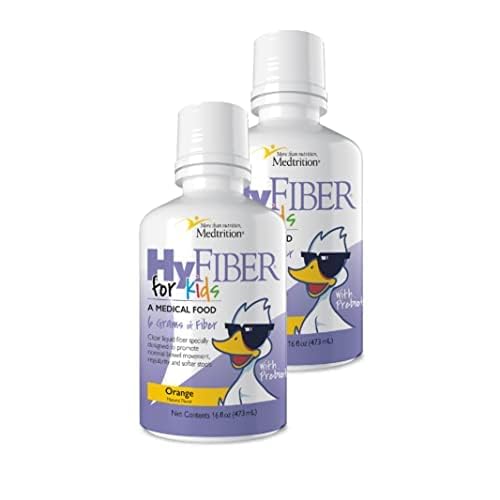
HyFiber Liquid Fiber for Kids

91 /100
Trail Score Outstanding

Key details

Formula
Fiber and FOS prebiotics, laxative-free
Serving Size
1 tablespoon
Fiber Per Serving
0.21 oz
Servings Per Bottle
32
Check Price on Amazon

A tablespoon. Not a scoop, not a stick pack, not three gummies. One tablespoon of liquid carries 6 grams of fiber, more than any other pick in this set delivers in a single serving. For a child who gags on powder or chews one gummy for ten minutes, the serving size is the entire product.

The formula is fiber plus FOS prebiotics, and it is explicit about what it leaves out: no laxatives, no PEG 3350, no soy, egg, gluten, dairy, peanuts, or tree nuts, and no sugar. That list matters more than it looks. Plenty of parents land here after being handed a daily laxative they want to stop, and this is the pick that says plainly it is not one.

It carries a faint orange note, noticeable to an adult and easy to bury in orange juice, and it is mild enough to take straight off the spoon. Two bottles at 32 servings each gives a long runway, and there is nothing to measure beyond a tablespoon you already own.

Where it wins is the house where nothing requiring a bowl and a stir gets eaten, because it turns fiber into a two-second job. If your child takes medicine from a syringe without a fight, this is the easiest arithmetic in the article: 6 grams, one tablespoon, once a day.

Pros

  • 6 grams of fiber in one tablespoon
  • No laxatives and no PEG 3350
  • Free of major allergens and added sugar
  • Takes seconds to give

Cons

  • Premium price for a two-bottle pack
Our verdict

For a kid who gags on powder, a tablespoon of barely-there liquid carrying 6 grams of fiber is the whole argument.

Check Latest Price
5

Best High-Fiber Gummy

Metamucil Kids Fiber Gummies

91 /100
Trail Score Outstanding

Key details

Count
120 gummies
Added Sugar
None added
Serving Size
3 gummies
Fiber Per Serving
0.18 oz
Check Price on Amazon

Five grams of fiber per serving is the highest of any gummy here, and the serving is three gummies, which quietly hands back the dial that gummies usually take away. One for a small kid, two for a middling one, three when you are working through a backlog. No added sugar, a plant-based fiber blend, and a mixed berry flavor that reads more like candy than medicine.

The bottle holds 120 gummies, which goes a long way even at the full three-a-day serving, and it is the format that makes this feel like a commitment: one flavor, one big bottle. Three gummies is also a fair amount of chewing for a preschooler, which is why this is not our toddler pick. It is the gummy for a five-year-old who wants three of anything.

Pros

  • 5 grams of fiber per serving
  • Three-gummy serving can be split
  • No added sugar, plant-based fiber
  • 120 gummies per bottle

Cons

  • Only comes in a 120-count bottle of one flavor
Our verdict

Three gummies deliver 5 grams of fiber, the most of any gummy here, and you can hand over one, two, or three.

Check Latest Price
6

Easiest Routine

Culturelle Kids Veggie Fiber Gummies

96 /100
Trail Score Outstanding

Key details

Dose
1 gummy, 1 to 2 times daily
Count
60 gummies
Sugar
No sugar added
Age Range
3 years and up
Check Price on Amazon

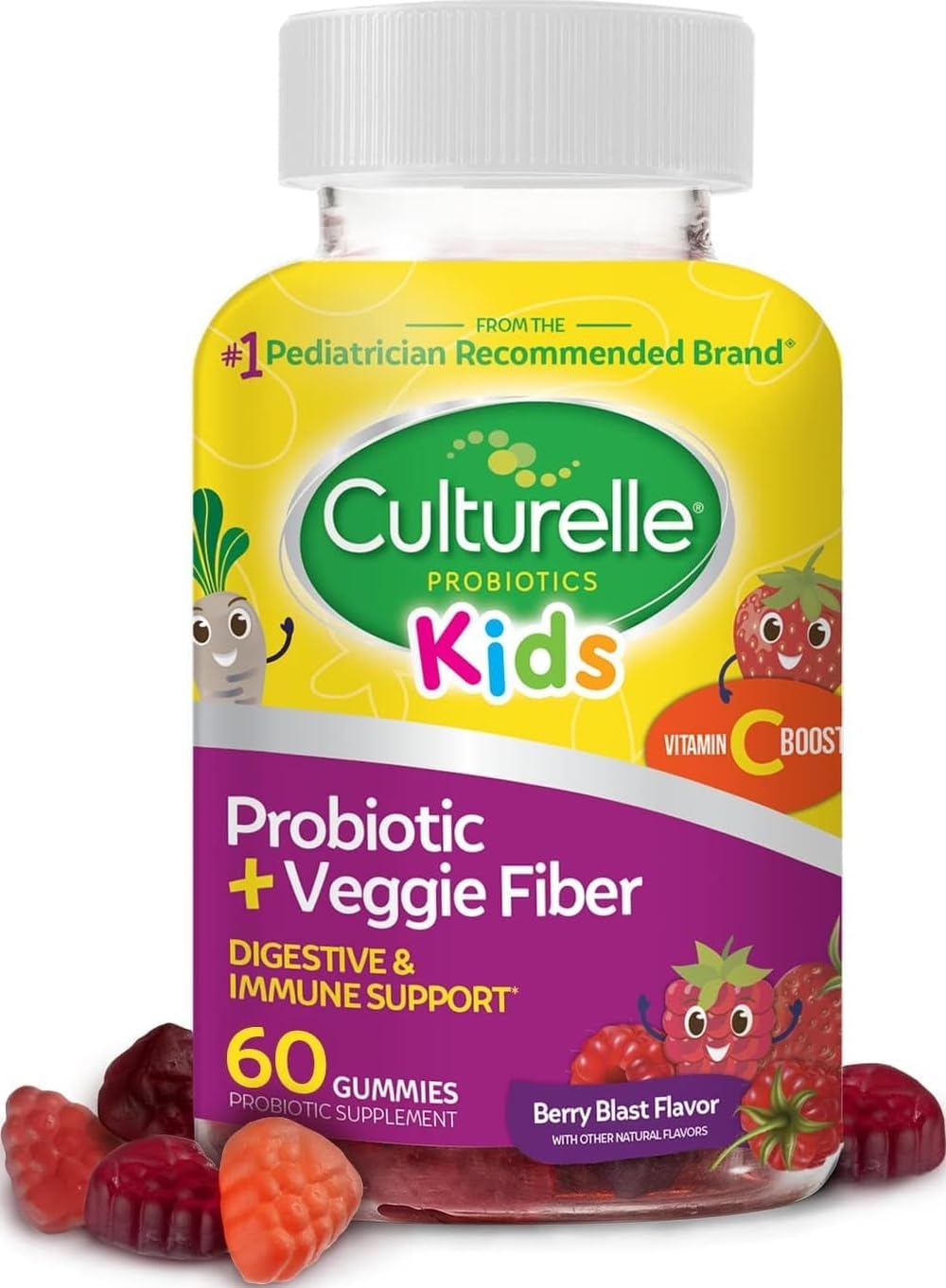
One berry gummy, once or twice a day, ages 3 and up. Of everything here, this asks the least of a child: no measuring, no stirring, no spoon, no argument. It is sugar-free, dye-free, non-GMO, and gluten-free, and it pairs a probiotic blend with prebiotic veggie fiber rather than standing on fiber alone.

What the label never gives you is a fiber number. It lists veggie fiber and a probiotic blend and stops short of grams, which is a real trade when constipation is the reason you are shopping, because without a number you cannot tell whether the second gummy is a meaningful step or nothing at all. What you do get is a small daily range, one gummy or two, which is more room than a fixed two-gummy serving.

It is the pick for a kid who already takes a daily vitamin and will not blink at one more bear, and for a parent who does not want to open a powder before coffee. Where it stops being enough is when you need to count grams, and the packets are built for exactly that job.

Pros

  • One gummy, once or twice a day
  • Ages 3 and up
  • Sugar-free, dye-free, and gluten-free
  • Probiotic plus prebiotic veggie fiber

Cons

  • Loose stools or stomach upset can show up in the first days
Our verdict

The easiest yes in this set: one berry gummy a day for a kid who will not touch a powder.

Check Latest Price
7

Gentle Ramp-Up

SmartyPants Kids Digestive Fiber & Veggies

90 /100
Trail Score Outstanding

Key details

Dose
1 gummy week one, then 2 daily
Count
60 gummies
Age Range
4 years and up
Fiber Source
Inulin prebiotic fiber
Check Price on Amazon

The label asks for one gummy the first week, then two. No other gummy here bothers with a ramp, and for a constipated kid with a sensitive gut, that slow start is the most thoughtful thing on the bottle. It gives you a week to see how the fiber lands before you commit to a daily dose.

The fiber is inulin, a plant-derived prebiotic that feeds gut bacteria rather than simply adding bulk. Prebiotic fibers are the ones that cause gas when you start at full strength, which is presumably why the ramp exists. The rest of the label is spare: mixed berry, and a third-party purity award the brand leads with.

Flavor is where this one splits the room harder than any other gummy in the set. The mixed berry draws strong reactions in both directions, and texture rides along with taste, since the gummy runs firm enough that a kid who wants a soft chew pushes back. There is no taste-testing it first at this size, so the first week is your audition.

Where it earns its place is the method rather than the number: a gentler introduction than anything else here, built around a fiber that does more than add bulk, for a child old enough to be past the toddler years. The trade is patience, since the ramp plus a week of watching means two weeks before you know whether it is working, and that feels long when your kid is uncomfortable.

Pros

  • Built-in one-then-two ramp
  • Inulin prebiotic fiber
  • Third-party purity testing on the label

Cons

  • Labeled for ages 4 and up
  • No fiber grams per serving on the label
Our verdict

A gentle-start pick: an inulin gummy with a built-in ramp, for kids past the toddler years who will chew a berry bear.

Check Latest Price
8

Youngest Kids

Mama Bear Kids Fiber Gummies

90 /100
Trail Score Outstanding

Key details

Diet
Vegan, gluten free, non-GMO
Flavors
Orange, strawberry, lemon
Age Range
2 years and up
Serving Size
2 gummies
Check Price on Amazon

Two gummies, three flavors, ages 2 and up, vegan and gluten-free, and no fiber grams anywhere on the label. For a supplement you are buying because of the fiber, that is the missing piece, and it is why this sits below the gummies that print a number.

What it does have is the youngest age floor of any gummy here, a bottle that is easy to justify trying, and three flavors in one jar, so a kid who turns on orange still has strawberry and lemon waiting. Two gummies a day, chewed thoroughly, and the formula is non-GMO as well.

Where it lands: the gummy we suggest when a two-year-old wants whatever an older sibling takes and you are not yet managing a real backlog. It is an inexpensive first step and a fine habit to build. It is not the bottle you build a plan around.

Pros

  • Labeled from age 2
  • Three flavors in one bottle
  • Vegan, gluten-free, non-GMO
  • Inexpensive enough to try

Cons

  • Chew and taste do not land with every kid
Our verdict

Cheap enough to try, and labeled from age 2, but the label never tells you how much fiber you are actually giving.

Check Latest Price

How We Chose and Tested Fiber Supplements for Kids

We started with labels rather than reviews, pulling every kids' fiber powder, gummy, and chew we could find and cutting anything with a fiber dose too small to matter, added sugar near the top of the ingredient list, or a serving size that meant a child would need three of them. That left 14 products, which we used in our own homes for four months, at the breakfast rush, in the after-school snack, and in the last drink before bed.

For powders, we mixed each one into four ounces of water, milk, applesauce, and yogurt, stirred for ten seconds, then looked again five minutes later to see whether it had stayed smooth or settled into a gritty layer at the bottom. Flavorless versions got a second round mixed into a drink with no announcement, to see if anyone noticed. We measured with the scoop or packet the label called for and timed the whole job on a school morning.

Gummies and soft chews went to a five-year-old and a nine-year-old who are honest to a fault; we noted whether a chew was hard enough to need real work, stuck to their teeth, or turned chalky, and whether they asked for another. Across all formats, we kept a simple daily log — how often each kid went, whether it seemed to strain or hurt, and any gas or cramping afterward — and compared grams of fiber per serving against how many servings the container held, since a supplement that needs two scoops a day is a different value than one that needs half.

How to Choose a Fiber Supplement for a Constipated Kid

Start With Grams, Then Check the Serving

Five grams sounds better than three until you see that five grams means three gummies and three grams means one. Find the fiber number, then find what it takes to get there, because that second figure is the one a small child has to cooperate with. A couple of the gummies in this guide print no grams at all, which means choosing them on faith rather than on dose. When constipation is the reason you are shopping, a printed number is worth more than a nicer flavor.

Match the Format to the Kid You Have

Gummies suit a child who already takes a chewable vitamin and hands over the same bear every morning. Unflavored powder suits a kid who eats yogurt or applesauce daily and does not inspect the spoon. Liquid suits the child who gags on powder and will not chew anything that tastes like a supplement.

The trap sits in the middle: a flavorless powder is only flavorless in the right vehicle. Culturelle's packet is explicitly not for hot food or drinks, and stirred into cold milk it can clump; spooned into applesauce it disappears. If your child takes nothing off a spoon, our pick for that house is the HyFiber liquid.

Dose Flexibility Beats a Fixed Serving

Constipation is managed by finding the amount that produces a comfortable, regular stool and staying there, which is why the Culturelle packets, the HyFiber liquid, and Metamucil's three-gummy serving are easier to work with than a fixed two-gummy dose. You move up one step at a time and watch for a few days. Starting at the maximum is how fiber earns its reputation for gas and cramping, so begin at the lowest labeled amount for a week before you change anything.

Read the Rest of the Label

Added sugar, sugar alcohols, dyes, and allergens carry more weight in something a child takes every day. No sugar added is not the same as unsweetened: several gummies here use sugar alcohols, and those behave nothing like sugar. Check the age floor too, since the labels in this set start at 1, 2, 3, and 4, and a formula built for a school-age kid is not automatically right for a toddler. One more line worth scanning is whether the product is a laxative, because PEG 3350 is a laxative rather than a fiber and one pick here says plainly that it leaves it out.

Frequently Asked Questions

Final Verdict

The Culturelle Kids Probiotic + Fiber Packets are what we hand to most families: a printed 3.5-gram dose, a label that starts at age 1, and a packet count you can raise one at a time, which is how constipation actually gets managed. Mix them into yogurt or applesauce and the powder disappears.

If your kid will not take a spoon, the HyFiber liquid puts 6 grams into a single tablespoon. If a toddler inspects every bite, Lovebug's flavorless stick packs are the softer landing.