Best CPAP Pillows for Side Sleepers of 2026

The worst part of CPAP therapy usually isn't the machine — it's the hiss. Around 3 a.m. you roll onto your side, your cheek presses the mask into the pillow, and the seal gives up with that thin whistling leak that wakes you and whoever's next to you. A CPAP pillow is meant to solve exactly that: a cutout or contoured edge gives the mask somewhere to sit so the cushion stays put while you sleep on your side. The catch is that the cutout has to match how you actually sleep — too shallow and the mask still gets shoved, too deep and your neck pays for it by morning.

I've spent the past six months sleeping on 11 of these pillows, cycling nasal pillows, a nasal mask, and a full-face mask through the lineup, and the gap between a good one and a bad one shows up within a week. The surprise for me was that firmness and loft matter as much as the shape of the cutout — plenty of pillows start plush and flatten into a pancake by week three, taking your neck alignment with them. The picks below are the ones where my seal and my neck both stopped complaining.

1

Best Overall

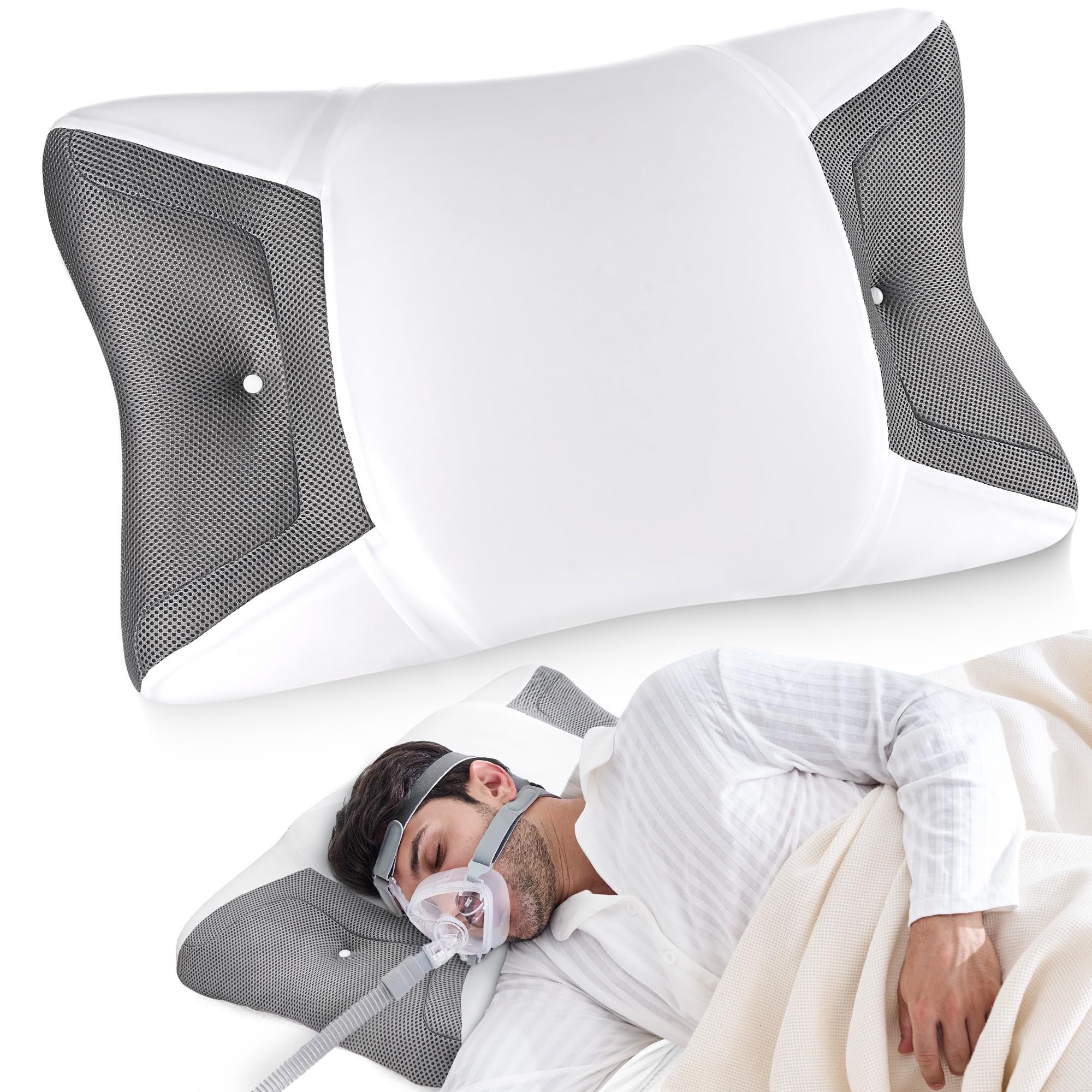
Lunderg CPAP Pillow

85 /100
Trail Score Excellent

Key details

Fill
High-density memory foam
Covers
Two, machine washable
Footprint
21.65 x 13.78 in
Loft Adjustment
1.1 in removable layer
Check Price on Amazon

The removable 1.1-inch foam layer is what earns this pillow the top spot. Pull it out and the loft drops to something closer to a flat contour; leave it in and you get a firm surface that keeps your head high enough to hang a mask off the side. That single adjustment covers the range most side sleepers move through, and it is the reason this is the pillow we point to first for someone who has no idea what height they need.

The two-sided contour is cut to clear a mask on either flank, and the mask compatibility is the broadest in this group: nasal pillows, nasal masks, full-face and hybrid. On our side with a full-face mask, the cutout kept the cushion off the foam rather than pressing it into a cheek. With a nasal-pillow mask there was enough room that the headgear didn't shift when we turned over, which is the whole job.

Density is where the money goes. At 5.1 pounds this is the heaviest pillow here, and the slow-rebound foam holds its shape through the night instead of packing down by three in the morning. That is the difference between a cutout that still clears your mask at dawn and one that has closed up around it.

The 21.65-by-13.78-inch footprint is the other thing to know. It is a compact pillow, so if you cover a lot of ground in your sleep you will spend part of the night half off it. Sleep roughly in one place and the size works in your favor, taking up less of the bed. Both covers are machine washable, and having a spare means wash day doesn't cost you a night.

Pros

  • Removable layer changes the loft
  • Fits nasal, pillow and full-face masks
  • Two washable covers included
  • Dense foam holds its height overnight

Cons

  • Firm foam that some side sleepers find hard
  • Premium price for a first CPAP pillow
Our verdict

Our default for side sleepers: adjustable loft, dense foam that holds its height, and cutouts that clear any mask type. Buy it unless you want a soft pillow or a wider surface.
Check Latest Price
2

Best for Full-Face Masks

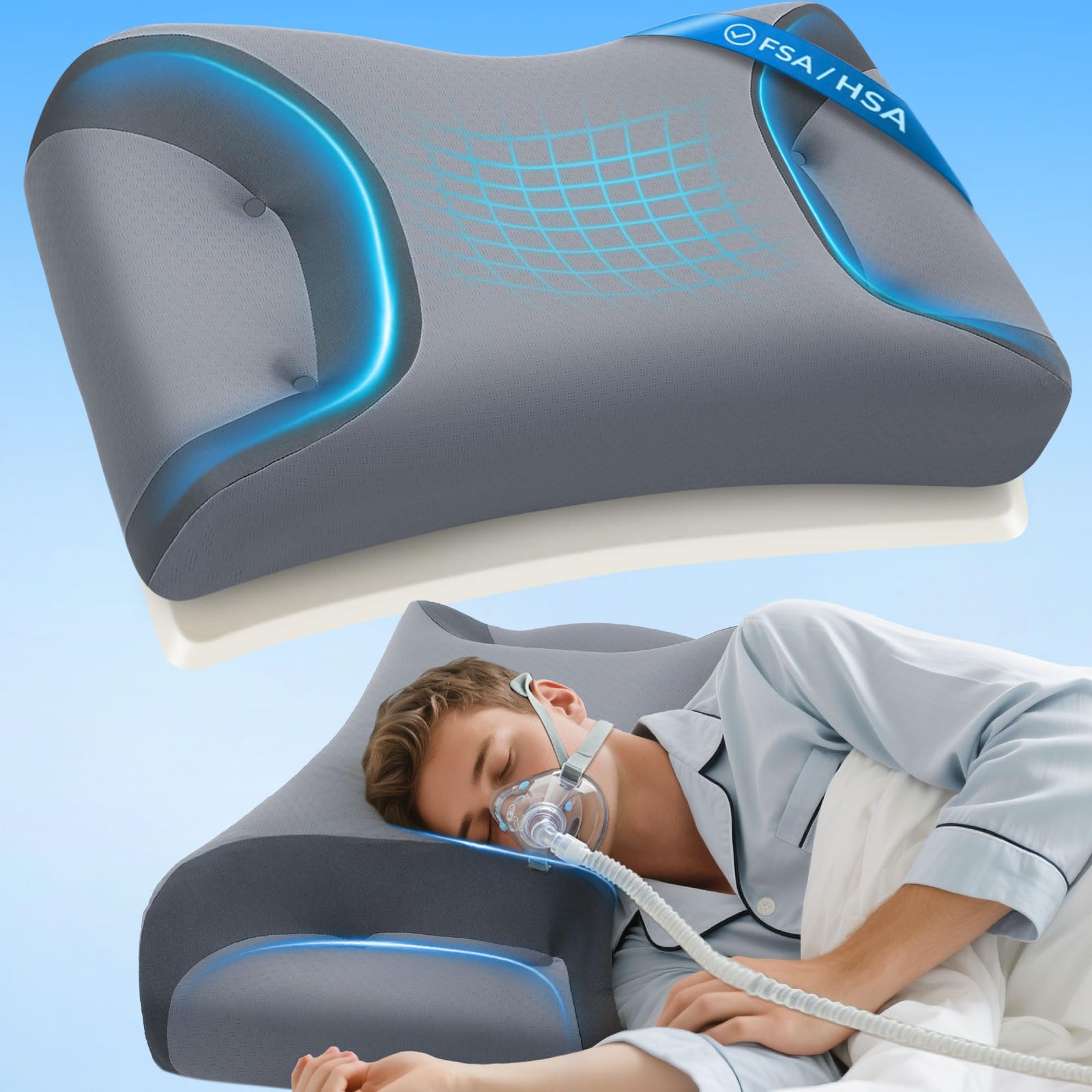
IKSTAR CPAP Pillow with Larger Cutouts

87 /100
Trail Score Excellent

Key details

Cover
Cooling, machine washable
Cutouts
Larger side cutouts
Footprint
24.8 x 13.8 in
Loft Adjustment
2 cm removable insert
Check Price on Amazon

If a full-face mask has ever been bulldozed sideways by foam, this is the pillow to try first. Its side cutouts are the largest of anything in this group, scooped deep on both flanks so the cushion sits in open space instead of being pressed back at your cheek.

Softer foam is the second half of that idea, and it is the part we appreciated most. Where the Lunderg holds you up firmly, this one gives a little, which lets a full-face mask settle instead of perch. Nothing about it feels under-filled; the butterfly shaping still puts a supportive edge behind the neck. But it is the plushest surface among the picks here, and lighter sleepers tend to do better with that give.

The 2 cm insert is the adjustment: leave it in for height, pull it for less, and expect a night or two to decide. The cover snaps at the corners so it doesn't slide, washes in the machine, and has an ear hole that keeps pressure off the side of your head. At 24.8 by 13.8 inches it is long rather than wide, which suits a pillow you stay fairly centered on.

Pros

  • Deepest side cutouts in this group
  • Softer foam eases pressure on a full-face mask
  • Removable 2 cm insert changes the loft
  • Cooling cover snaps on and washes

Cons

  • Soft foam may sink under a heavier head
  • Premium price
Our verdict

We recommend this one when a full-face mask is the problem: the deepest cutouts here and softer foam let the cushion sit rather than perch. Skip it if you want firm support.

Check Latest Price
3

Best Adjustable Height

IKSTAR Adjustable CPAP Pillow

84 /100
Trail Score Excellent

Key details

Fill
High-density memory foam
Cover
Cooling, machine washable
Footprint
25.2 x 14.96 in
Contour Heights
Dual-height plus 2 cm insert
Check Price on Amazon

The Lunderg gives you one removable layer. This IKSTAR gives you a dual-height contour plus a 2 cm insert, and for a broad-shouldered side sleeper that difference is the whole purchase. A pillow that sits too low drops your head below your spine and lets the mask close against the mattress.

It is built tall, with a scooped center and raised side wings that stop your shoulder pushing the pillow out from under you. The cooling cover is machine washable and the ear recess gives the side of your head somewhere to sit, a detail we noticed on the third night rather than the first, once we stopped waking with a sore ear.

What settles it for us is the tuning range. Two contour heights before you touch the insert mean you fine-tune instead of choosing between high and higher, and the foam rebounds slowly enough that a night's pressure does not leave a trench. If you have been folding a towel under your pillow to get the height right, this is the pillow that replaces the towel.

Pros

  • Dual-height contour plus 2 cm insert
  • Tall loft suits broad shoulders
  • Cooling cover with an ear recess
  • Foam holds its shape overnight

Cons

  • Tall loft can overwhelm smaller frames
Our verdict

Pick this if you need real loft for broad shoulders. Two contour heights plus a 2 cm insert make it the easiest pillow here to tune to a tall side-sleeping position.

Check Latest Price
4

Best for Side and Back Sleeping

HOMCA CPAP Pillow

83 /100
Trail Score Excellent

Key details

Fill
CertiPUR-US memory foam
Cover
Removable, machine washable
Heights
4.33 in and 3.54 in
Footprint
25.59 x 15.75 in
Check Price on Amazon

The notches on this pillow sit at the two ends rather than wrapping the corners, and that placement decides whether it works for you. If your mask sits forward on your face, the recess is exactly where the cushion lands. If your headgear puts the cushion back toward your ear, you are lying on solid foam and the cutout is decoration.

Two heights in one pillow is what we liked most. One side measures 4.33 inches, the other 3.54, so flipping the pillow is the entire adjustment, with no inserts to lose and no layers to store. The scooped center cradles the back of the head, which kept the seal intact when we rolled from side to back in the night, and at 3.5 pounds the pillow stays where you put it.

At 25.59 by 15.75 inches it is one of the roomier pillows here, and that matters if you turn often. The cover comes off for the machine, and the foam is both CertiPUR-US certified and Oeko-Tex approved. We noticed no odor out of the box, which is not a given with memory foam that has been compressed in a carton.

Pros

  • Two heights, flip to switch
  • Wide surface with room to turn
  • Center cradle holds the head
  • Washable cover, low odor

Cons

  • Too low for some side sleepers
Our verdict

A sensible midrange choice if your mask sits forward on your face, where the end notches land. Two heights to flip between and a wide, roomy surface.

Check Latest Price
5

Best Adjustable Firmness

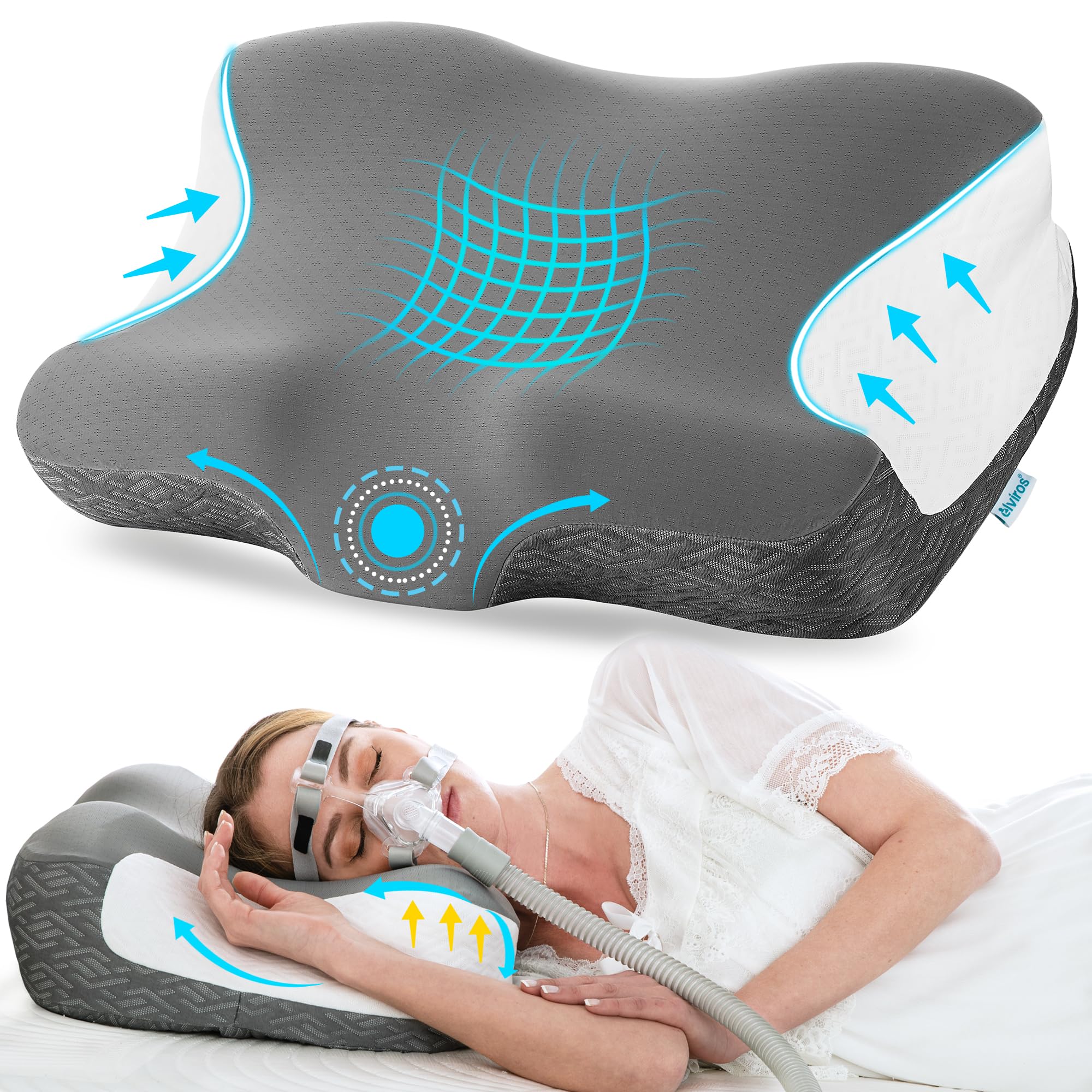
Elviros Adjustable CPAP Pillow

80 /100
Trail Score Excellent

Key details

Heights
4.9 / 5.1 in, or 4.1 / 4.3 in with spacer out
Inserts
Softer and firmer
Footprint
23.6 x 16.3 in
Certification
CertiPUR-US
Check Price on Amazon

Two inserts, one softer and one firmer, plus a base spacer that drops the whole pillow by 0.8 inch: this is the most adjustable pillow in the group, and it is why we recommend it to anyone buying a first CPAP pillow without knowing what they need.

The four resulting heights cover the range where most side sleepers land, and swapping the insert changes the feel more than you might expect. The firmer one borders on rigid; the softer one gives enough that a nasal mask settles into the cutout instead of sitting on top of it. The 16.3-inch width is the widest in this set, so your shoulder has somewhere to go when you roll.

The caveat is the shape. There is a pronounced cervical roll behind the neck, and it takes a week or two before it stops feeling like a foreign object, worth knowing if you have reacted badly to contoured pillows before. The cover is a cool-touch nylon-spandex blend that washes easily, and the foam core is spot-clean only, so a spill stays on the cover or becomes your problem.

Pros

  • Four loft settings, 0.8 in spacer
  • Softer and firmer inserts included
  • Widest surface in this group
  • CertiPUR-US memory foam

Cons

  • Pronounced neck roll needs a break-in
Our verdict

The safest buy for a first CPAP pillow: four heights and two foam inserts let you find your loft instead of guessing at checkout, on the widest surface here.

Check Latest Price
6

Best Budget

Joynox CPAP Pillow

83 /100
Trail Score Excellent

Key details

Cover
Cooling, removable
Weight
2.7 lb
Heights
3.5 in and 4.33 in
Footprint
25.6 x 15.8 in
Check Price on Amazon

The least expensive pillow in this group is also one of the lightest at 2.7 pounds, and for a first CPAP pillow that combination is hard to argue with. Nothing about it reads as cut-rate: the foam is CertiPUR-US certified, the cover is a cooling nylon-spandex blend, and both sides have cutouts.

Two heights, 3.5 and 4.33 inches, give you a low side for back sleeping and a higher one for your side. At 25.6 by 15.8 inches it is a full-size pillow with room to roll, and the cupped head area matters more than we expected, keeping your head from drifting toward the edge of the cutout where leaks usually start.

Loft is where it gives ground. Under a heavy head this is the pick most likely to feel thin, and if you are broad across the shoulders you will want more height than it offers. For a smaller sleeper, a back-and-side mix, or someone who wants to find out whether a cutout design helps without spending much, hand this one over the premium pillows.

Pros

  • Lowest price in this group
  • Two heights for side and back
  • Full-size surface with room to turn
  • CertiPUR-US foam, cooling cover

Cons

  • Top loft is only 4.33 inches
Our verdict

The lowest-cost way into a cutout pillow, and a good one for back-and-side sleepers. Go elsewhere if you need more than 4.33 inches of loft.

Check Latest Price
7

Firm, Tall Support

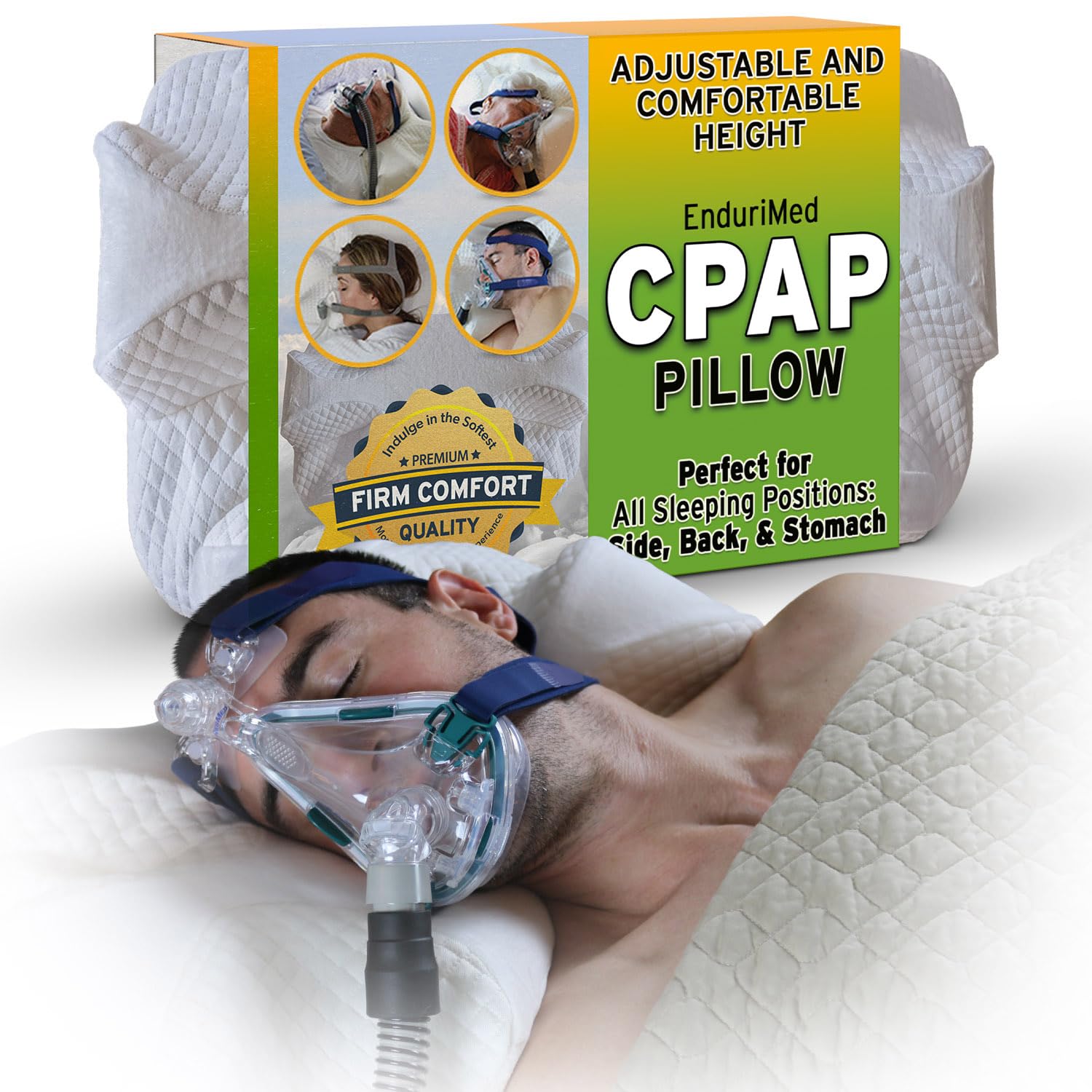
EnduriMed CPAP Pillow

82 /100
Trail Score Excellent

Key details

Height
5.12 in
Footprint
22.44 x 11.81 in
Hose Clearance
Corner gaps
Loft Adjustment
Removable foam pad
Check Price on Amazon

This is the longest-running design in the group, and the shape it settled on is unusual: two corner gaps instead of full side cutouts, a 5.12-inch height, and a face just 11.81 inches wide.

The corner gaps do a job the side cutouts cannot. Sitting at the bottom corners, they give the hose somewhere to run and keep straps out of the foam when you are square on your side. The difference showed up most with a nasal-pillow mask, where tubing tug rather than cushion pressure was what broke the seal.

Just over five inches is a lot of pillow. It suits a broad frame and a firm mattress and can feel like too much if you are small or sleeping on something soft. The removable foam pad is a layer rather than a second contour, so it lowers the height without changing the shape underneath.

Where we land is that this is a pillow for a specific sleeper: broad shoulders, a tall setup, and a hose that keeps tugging. If two of those three do not describe you, one of the wider, lower picks here will be easier to live with.

Pros

  • Corner gaps keep hose and straps clear
  • Tall 5.12-inch build for broad frames
  • Removable pad lowers the loft
  • Mask stays in place overnight

Cons

  • Narrow 11.81-inch width
  • Firm foam that some find too hard
Our verdict

Worth it if tubing tug is what breaks your seal, since the corner gaps address a problem the side-cutout pillows ignore. The narrow, firm build suits a specific sleeper.

Check Latest Price

How We Tested the Best CPAP Pillows for Side Sleepers

We started by pulling specs on more than 40 pillows sold as CPAP-friendly — cutout depth and width, fill material, loft height, listed firmness, cover fabric, and whether the cover could go in a washing machine — and narrowed that to 11 that spanned contoured foam, adjustable fill, and simple cutout shapes. Price factored in, but only next to whether the design lined up with a mask; a cutout in the wrong place costs the same as one in the right place.

Over six months, each pillow spent at least two weeks on my bed and rotated through two other side sleepers using different mask styles. On day one I measured loft at the center and at the edge of the cutout, then measured again at the end of the trial to see how much it had flattened. Every night I noted whether rolling from my back onto my side broke the seal — the machine's leak numbers and my own 3 a.m. wake-ups both counted — and whether the cutout actually cradled the mask or just nudged it sideways.

In the morning I logged neck stiffness and where my chin ended up, since a pillow that protects the seal but drops your jaw isn't much of a trade. Covers went through the wash weekly, and I tracked pilling, shrinkage, and whether the foam survived a full dry cycle; whole pillows got washed wherever the care tag allowed. We also checked fit under real movement — whether the mask stayed steady when I turned over, not only when I lay perfectly still — and kept a running note on whether each one still felt worth its price two months in.

How to Choose a Cpap Pillow for Side Sleeping

Start With Where Your Mask Sits

The cutout is only useful if your mask lands in it. Full-face masks need a deeper, wider recess because the cushion occupies more of your cheek; nasal pillows need less room but are more sensitive to headgear straps dragging on foam. Placement matters as much as size. A recess at the pillow's ends helps a mask that sits forward on your face and does nothing for one that sits back toward the ear, which is the difference between the HOMCA and a pillow with full corner cutouts.

Before the return window closes, put the pillow on your bed, put your mask on, and lie on each side. If foam touches the cushion anywhere, keep looking. That two-minute check tells you more than any specification on this page.

Loft: The Adjustment That Does the Most

Side sleeping wants your head level with your spine, which means more height than back sleeping needs. Too little and your head drops until the mask closes against the mattress; too much and your chin tucks and the cushion lifts at the nose. This is why the adjustable picks earn their place here: a removable layer, a spacer, or two contour heights lets you correct the height in your own bedroom instead of guessing at checkout.

Start high and take height out rather than the reverse. It is far easier to remove a layer than to add one back.

Firmness and How Far You Sink

Firmness divides sleepers more sharply than anything else in this category, and it isn't only a matter of taste. Foam soft enough to let your head sink closes the recess you bought the pillow for; foam firm enough to hold you up can press a new pressure point into your jaw or temple.

If you don't know which side of that line you fall on, buy a pillow with two inserts or two contours and change it after a week. A pillow that feels wrong on night one often feels right by night five.

Covers, Cleaning, and Heat

A CPAP pillow spends seven or eight hours a night against your face, under a mask and straps, and the foam core cannot go in the washing machine. That makes the cover the part you actually live with: check it is removable, machine washable, and roomy enough to go back on without a wrestling match. A cooling fabric helps if you wake with a hot cheek where the mask meets the pillow.

Two covers, as the Lunderg includes, mean wash day doesn't cost you a night of therapy.

Footprint and Pillowcases

The pillows here run from 11.81 to 16.3 inches wide, and that range decides how much room you have to turn. A narrow pillow keeps your mask from dragging across a wide surface but leaves less margin if you move around in the night.

Size also affects the case. An ordinary pillowcase pulled over a cutout pillow can bridge the recess and put fabric back under your mask, so use the fitted cover that comes with it, or a loose case you can pull taut around the edges.

Frequently Asked Questions

Final Verdict

The Lunderg is the pillow we recommend to most side sleepers. The removable layer handles loft, the dense foam holds its height until morning, and the contours clear every mask type, which no other single pick here manages. If a full-face mask being pushed sideways is your specific problem, the IKSTAR with the larger cutouts solves it better. If you need more height than either offers, the second IKSTAR gives you two contour heights plus an insert.

Whichever you choose, treat the first week as setup rather than a verdict: change one thing at a time, loft first and then firmness, and give the seal a few nights to settle.