Best Compression Boots for Recovery of 2026

Compression boots work by squeezing your legs in waves, like a massage therapist who never gets tired. That sounds straightforward, but the difference between a pair that genuinely helps you recover and one that just takes up closet space comes down to fit, pressure control, and whether the battery lasts through a full session. Over the past six months, my team and I have lived with eight different pairs—from compact sleeves to full-leg boots—and the gap in quality is wider than you'd expect.

I've come to look at my evening sessions as a small ritual: twenty minutes of quiet pressure while I read, and my calves feel noticeably looser the next morning. The one thing first-time buyers often overlook is size—not just your height, but your calf circumference, since a loose sleeve won't deliver an even squeeze. The picks below range from durable daily drivers to compact, travel-friendly sets, so you can match one to your recovery routine and budget.

1

Best Overall

Air Relax AR-2

91 /100
Trail Score Outstanding

Key details

Weight
8 lb
Chambers
4
Therapy Modes
3
Pressure Levels
8
Check Price on Amazon

Only one system in this guide is sold as an FDA-cleared medical device, and it is the one we recommend first. The Air Relax AR-2 runs four chambers through three modes — a peristaltic wave that works from the foot upward, a uniform cyclical squeeze, and a continuous hold — with eight pressure levels behind them. That is enough range to make a session feel like a real massage rather than a tourniquet.

What earns it the top spot is the whole package rather than any single number. It treats foot, calf and thigh in one sequence, the controls sit on the pump instead of buried in a phone app, and it costs a good deal less than the name most people search for. The sleeves zip on over bare legs or thin leggings, and the pump is small enough to live under a side table between sessions.

We are also taken with how little fuss there is. Three labelled modes, a pressure setting that steps up rather than jumping, and a timer that shuts the pump off by itself — the AR-2 is the system here you can start half-asleep and finish asleep. Air Relax describes the garment as biocompatible and lead-free, which counts for something in a product worn against the skin several times a week.

The one thing it is not is portable. Eight pounds of pump and two full-length sleeves want a permanent spot near a couch, and there is no case to take it anywhere. Ours sits beside the sofa and gets used while the kettle boils, which is exactly the level of effort a recovery habit needs to survive.

Pros

  • FDA-cleared, medical-grade pump and sleeves
  • Four chambers cover foot to thigh
  • Three distinct modes and eight pressure levels

Cons

  • One-year warranty, shorter than the two-year rivals
Our verdict

We recommend it to most people: four chambers covering the whole leg, three therapy modes, and FDA-cleared parts, at a price far below the premium badge.

Check Latest Price
2

Best Value

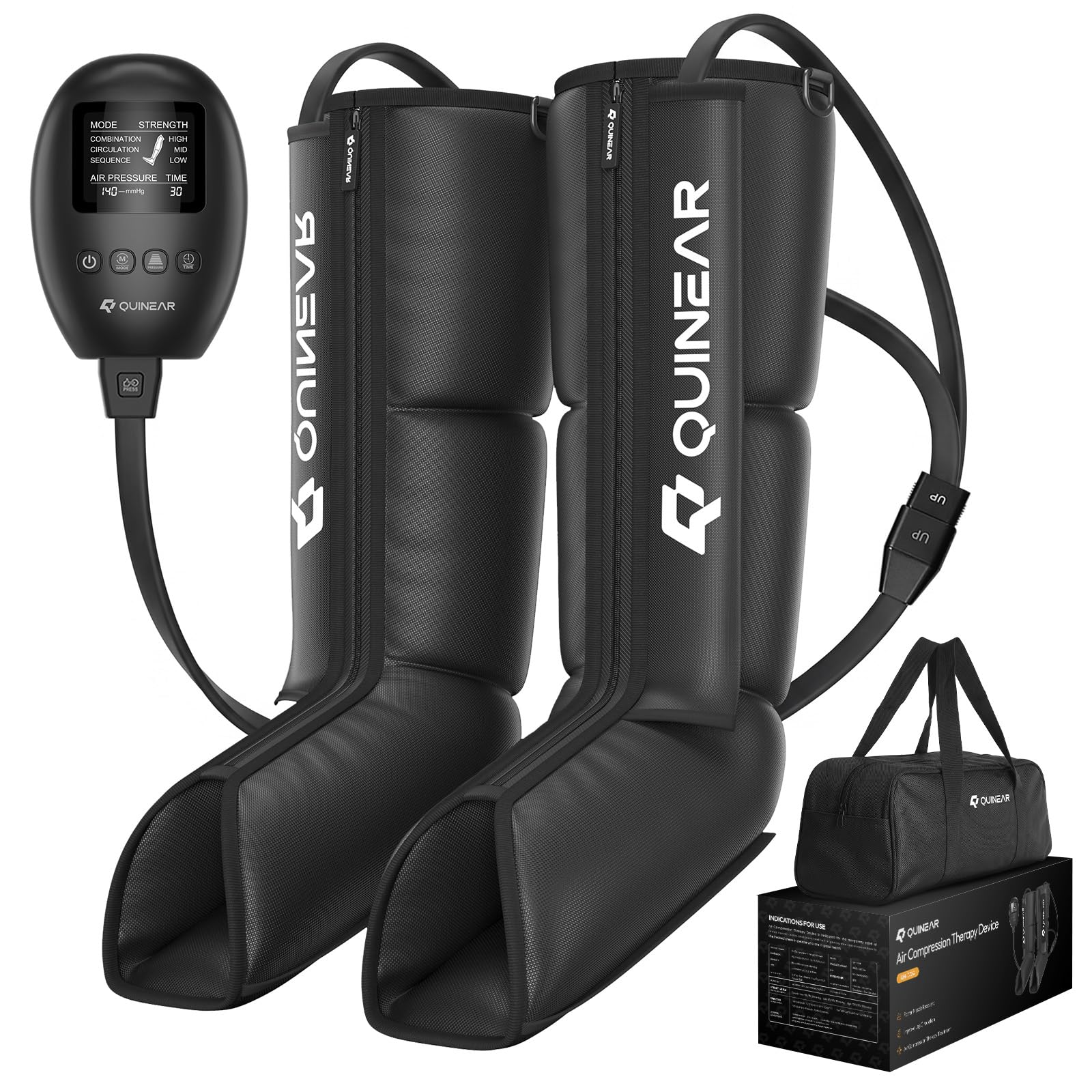
QUINEAR Air Compression Boots

88 /100
Trail Score Excellent

Key details

Modes
3
Weight
7.17 lb
Chambers
4 (foot, calf, thigh)
Pressure Range
50-120 mmHg
Check Price on Amazon

A sensor inside the pump reads how much air your leg will take and adjusts the squeeze to match, which sounds like a small thing until you have spent a session guessing at pressure. The QUINEAR fills each of its four chambers — foot, calf, thigh — to a firmness it settles on rather than one you dialled in blind. Eight intensity steps from 50 to 120 mmHg sit behind that, along with three modes and three timers.

This is the value pick of the group, and it earns that on coverage rather than corners. Full-leg sequential compression, a controller you can read in a dim room, and sleeves that close over a solid calf without a fight. At just over seven pounds it is light enough to shift between rooms, though the boot panels are long, so it wants a corner where it can stay set up.

The pump is the part to watch. Some of these fail inside two years, which would be a serious problem if the warranty were shorter — QUINEAR covers it for 24 months, and that is why we are comfortable recommending it at this money. Buy it as an appliance with a defined life rather than a buy-once piece of kit, keep the receipt, and the arithmetic works.

What we keep coming back to is how little it asks of you. Zip in, press a mode, and the thing works its way up the leg while you read. That ease is worth more than an extra chamber or an app you will open twice.

Pros

  • Pump adjusts pressure to your leg size
  • Foot, calf and thigh coverage
  • Eight intensities, three modes, three timers
  • Two-year warranty backs the pump

Cons

  • Sizing is the weak point; check the chart first
Our verdict

Our value pick: full foot-to-thigh compression, eight pressure steps and a pump that reads your leg size, for anyone building a recovery habit without a clinic budget.

Check Latest Price
3

Best Premium

Hyperice Normatec 3

88 /100
Trail Score Excellent

Key details

Power
Rechargeable battery
Zones
5 overlapping
Weight
13.5 lb
Compression Levels
7
Check Price on Amazon

Price is the first thing to reckon with here, since this is comfortably the most expensive system we recommend, and it is worth knowing what the extra buys before you commit. What it buys is the most refined sequence in the group: five overlapping zones rather than four separate chambers, seven intensity levels, and ZoneBoost, which pushes extra pressure into a section you choose.

The overlapping design is the actual difference. Instead of inflating one chamber at a time, the sleeve hands pressure along so the leg is never fully released mid-cycle. That reads as a smoother, more continuous squeeze than the discrete-chamber boots here — closer to a pair of hands working up the calf than to a cuff inflating.

The rest is convenience rather than performance. The control unit is lighter and simpler than the previous generation, sessions can be adjusted over Bluetooth in the Hyperice app, and an internal battery means no cord across the floor. At 13.45 pounds it is the heaviest set here, and the app is the least important part of it — a well-cut sleeve and a good pump do the work.

So the question is whether the last five percent of refinement is worth the premium to you. For a competitive athlete in boots most days, the smoother sequence and the badge are easy to justify. For a recreational runner who wants a squeeze after weekend long runs, the Air Relax gets most of the way there for a lot less.

Pros

  • Five overlapping zones with ZoneBoost
  • Seven levels plus Bluetooth app control
  • Internal battery, no cord needed

Cons

  • Most expensive system in this guide
  • Heaviest set here at 13.45 pounds
Our verdict

If recovery is a serious part of your training and cost is not the constraint, the five-zone sequence here is the most refined we tested.

Check Latest Price
4

Best Cordless

FIT KING FT-091A Cordless

87 /100
Trail Score Excellent

Key details

Weight
9.81 lb
Zone Control
4 zones
Pressure Range
40-150 mmHg
Pressure Levels
12
Check Price on Amazon

No cord, no outlet, no rearranging the furniture to use it — the FT-091A runs off a rechargeable controller, and that single change alters when and where you actually put the boots on. Twelve pressure settings from 40 to 150 mmHg give you everything from a light flush to a genuinely firm squeeze.

Zone control is the feature we value most. Each of the four sections — foot, lower calf, upper calf, thigh — can run on its own, so a tight calf gets the whole session while the rest of the leg sits out. That is more granular than most systems here, and it turns the boots into a spot-treatment tool as well as a full-leg routine.

Ten time settings between 15 and 60 minutes cover a quick flush before bed or a long session after a race, and the two-year warranty is the better end of what this group offers. The kit comes with a carry case, which is the difference between taking it to a hotel and leaving it in the hallway.

What you give up is money and muscle. The battery is what you are paying for over the corded systems, and if the boots live beside the sofa, that premium buys you very little. For anyone whose recovery happens at a gym, a track, or a hotel room, cordless is the feature you notice every single time.

Pros

  • Runs entirely on its rechargeable battery
  • Four zones you can run individually
  • 12 pressure levels and 10 time settings
  • Two-year warranty included

Cons

  • Heavier than the corded systems at 9.81 pounds
Our verdict

Buy it if your recovery happens away from an outlet — four independently controlled zones and 12 pressure levels, all running off the battery.

Check Latest Price
5

Best Budget

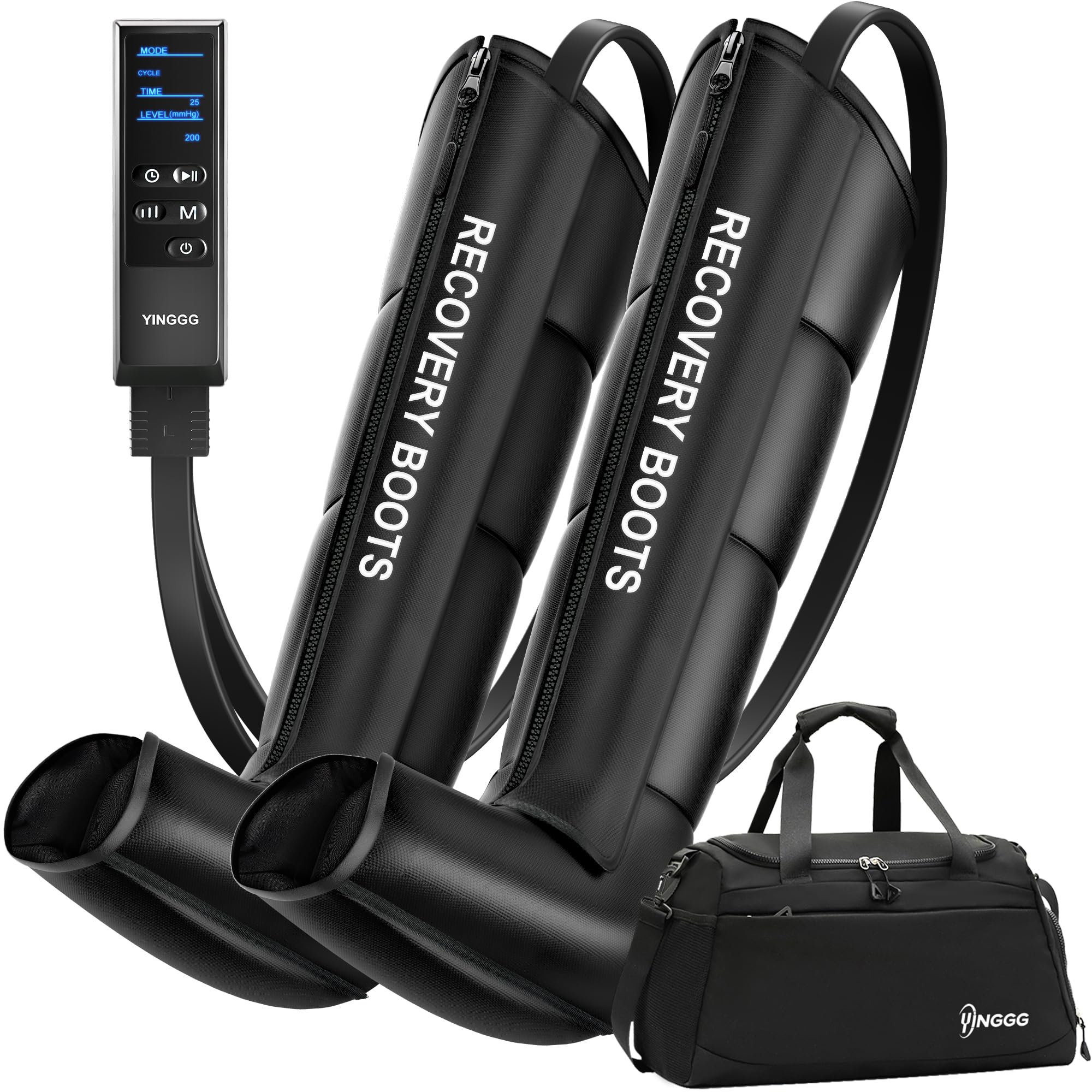
YINGGG Air Leg Massager

84 /100
Trail Score Excellent

Key details

Modes
6
Timers
15, 20, 25 min
Weight
6.9 lb
Pressure Range
60-200 mmHg
Check Price on Amazon

Two hundred mmHg is the highest pressure ceiling in this guide, and on a budget system that number deserves a raised eyebrow rather than applause. What it means in practice is headroom: the YINGGG can go firmer than several systems costing multiples of its price, which is useful after a heavy leg day and unnecessary on a rest week. Nine intensity steps and six modes let you stay well below the top.

What the money does buy is real coverage: a 360-degree wrap from calf to thigh, three automatic timers at 15, 20 and 25 minutes, and a pump rated under 50 dB, quiet enough to use in front of the television without subtitles. It remembers your last settings, so starting a session is two button presses and no thought.

The compromises sit where you expect them. Coverage begins at the calf, so the foot sequence the four- and five-chamber systems provide is not part of the deal — worth weighing if you are a runner whose feet take the beating. There is also no long history to lean on: this is a new design, and the durability question is open in a way it is not for the QUINEAR or the FIT KING.

None of that makes it a bad buy. As a first pair, or a second pair kept at the office, the YINGGG does the core job for the least money here, and if it turns out you never use it, you have lost the least. If you are replacing a set that died, spend more and get the warranty.

Pros

  • Highest pressure ceiling here at 200 mmHg
  • Six modes and three session timers
  • Quiet pump rated under 50 dB

Cons

  • Coverage starts at the calf, not the foot
  • New design with little long-term history
Our verdict

A low-cost way to find out whether compression boots earn a place in your week, with the highest pressure ceiling here and calf-to-thigh coverage.

Check Latest Price
6

Small Spaces

QUINEAR Leg Recovery System

87 /100
Trail Score Excellent

Key details

Modes
3
Weight
4.74 lb
Programs
10
Air Channels
3
Check Price on Amazon

At 4.74 pounds it is the lightest system we recommend, and the weight changes the routine more than the spec sheet suggests. This one gets carried to the bedroom, tucked into a trunk, or folded into a drawer — the pump is small and the sleeves pack flat enough that getting set up is not a decision you have to make in advance.

Underneath it is a three-channel system with ten preset programs, three modes and three intensities, run from a handheld controller with an LED display. That is one chamber fewer than the four-chamber boots here, and the result is a gentler, more even squeeze rather than a deep one. For soreness the night after a workout, gentle and even is usually what you want.

The sleeves are the detail we like best. They are made from a wipe-clean fabric and close with zips rather than hook-and-loop straps, which is quicker to get in and out of and does not snag on socks. It is also FSA- and HSA-eligible, so if you have a balance sitting in a benefits account, part of the cost can come out of money you already set aside.

The limit is intensity, not quality. Runners chasing a deep, high-pressure flush after a marathon block want more pump than this delivers, and the four-chamber systems are built for exactly that. Everyone else gets a system that is easy enough to use on a Tuesday night, which is the only test that really matters.

Pros

  • Lightest system here at 4.74 pounds
  • Ten preset programs, three modes, three intensities
  • Zippered wipe-clean sleeves
  • FSA- and HSA-eligible purchase

Cons

  • Three channels, fewer than the four-chamber boots
Our verdict

The one to keep within reach: three channels, ten programs and a handheld controller in a kit light enough to move from room to room.

Check Latest Price

How We Tested (and Lived With) Eight Compression Boots

We started by scanning the market for recovery boots with different pressure styles, battery setups, and size ranges, then narrowed the list to eight models that represent the most common configurations—compact sleeves, full-leg boots, and corded versus battery-powered options. Over six months, we used each pair at least three times a week, rotating them among testers with different leg shapes and heights.

Testing happened where recovery actually happens: after morning runs, at the end of long workdays, and during quiet Sunday evenings on the couch. We wrapped a tape measure around each tester's calf and thigh, then checked whether the boot's sleeve stayed snug without pinching or sliding. For battery life, we fully charged each unit and timed how many 20-minute sessions it completed before the indicator went dark. We also noted how long each pair took to inflate, whether the pump noise was low enough to read or watch TV, and whether testers looked forward to the forced downtime or found the sensation too intense.

We tested compression by cycling through every pressure setting and feeling whether the squeeze moved evenly from ankle to calf or bunched in one spot. To judge recovery and effectiveness, testers rated calf tightness and soreness each morning after using the boots the night before. For durability and quality, we inspected seams, zippers, and air hoses after every week of use, looking for fraying, leaks, or loose connections. Value came down to what you get for the money: number of pressure zones, washable sleeves, carry cases, and how often the boots needed recharging.

How to Choose Compression Boots for Recovery

How Much of the Leg Gets Compressed

Chambers are the air bladders inside the sleeve, and how they are arranged matters more than the badge on the pump. A four-chamber boot inflates foot, calf and thigh in sequence; an overlapping five-zone system hands pressure from section to section so the leg is never fully released. Neither is automatically better — overlapping zones feel smoother and more continuous, discrete chambers feel firmer and more rhythmic.

Answer the coverage question first. The YINGGG runs calf to thigh, which is plenty for sore quads but leaves the foot out; the Air Relax and the QUINEAR boots both take the sequence down to the foot. If you run or stand all day, foot coverage is the part you notice.

Fit Is the Specification That Decides Everything

Boots are sized by leg length and, in practice, by calf and thigh circumference. A sleeve that runs long rides into the groin and pushes the thigh chamber off the muscle; one that runs short stops mid-thigh and leaves the top of the leg untreated. Height alone is a poor guide — two people of the same height can land in different sizes.

Measure your inseam and the widest part of your thigh and check both against the seller's chart before ordering. The QUINEAR in Large is a genuinely big boot, and the Normatec 3 Standard starts at a 31-inch inseam. If the chart gives only one of the two measurements, ask before you buy.

Corded or Cordless

Battery power costs money and adds weight: the FIT KING cordless kit carries 9.81 pounds against 7.17 for the corded QUINEAR. What you get in exchange is a session on the sofa, in a hotel room, or at the side of a track without hunting for an outlet.

Be honest about where the boots will live. If they never leave the den, a corded pump is cheaper, lighter, and one less thing to recharge. If you travel to races or work long shifts on your feet, the battery is the feature you will notice every single day.

Pressure, Modes, and Session Length

Millimeters of mercury is a ceiling, not a target. Most sessions land well below the maximum, and a system that tops out at 120 mmHg is not automatically worse than one that reaches 200 — what matters is whether the pump holds a steady, even squeeze at the level you like. A high ceiling is headroom, not a promise of a better massage.

Three modes cover almost everything: a sequential wave, a uniform squeeze, and a continuous hold. Look for a timer that shuts the pump off by itself, so a 20-minute session does not become an hour because you fell asleep.

Durability, Warranty, and the Cost of a Failure

The pump and the zippers fail long before the sleeves wear out, so the warranty is part of the product rather than a footnote. Two years — what QUINEAR and FIT KING offer — covers a bad pump without an argument; one-year coverage is more common at the lower end of the range and at the very top of it.

Either way, a claim means time without boots. If you plan to use them daily, register the product the week it arrives and keep the packaging. A budget system with a short track record is worth buying only once you know the habit will stick.

Frequently Asked Questions

Final Verdict

Across the six systems we recommend, the Air Relax AR-2 is the one we point most people to. It covers the full leg, runs a sequence that feels like a massage rather than a blood-pressure cuff, carries FDA-cleared status, and costs far less than the badge it is usually compared with — which is most of what decides whether boots get used.

If your training is serious and cost is not the constraint, the Normatec 3 is a step smoother and worth the premium. If your sessions happen away from home, the FIT KING cordless is the better buy, and if you are not yet sure the habit will stick, start with the YINGGG and find out cheaply.