Best Colic Drops for Newborns of 2026

A baby who has been fed, changed, and walked around the block and is still crying can make the baby aisle feel like a maze of maybes. Colic drops won’t magically reset every evening, but the right formula can make burping easier, take the edge off hiccups, and turn a long gas cry into something closer to a normal newborn fuss. That’s the job: not a cure-all, just one less thing between you and a calmer house.

I’ve now spent four months with 14 different formulas, mostly during night feeds and the graveyard shift between dinner and bedtime. The ones that stood out got the small things right—a dropper with readable markings, a consistency that didn’t glob at the tip, a taste babies didn’t immediately push back out, and seals and ingredient panels that felt trustworthy. We also watched for side effects, tracked dirty diapers and burps, and compared bottle size and cost per dose so you’re not paying for a pretty label. The picks below are organized around what actually made those late nights easier.

1

Best Overall

BioGaia Baby Probiotic Drops

93 /100
Trail Score Outstanding

Key details

Feeding
Breast, bottle, or mixed
Formula
Probiotic drops
Free From
Dairy, soy, gluten, sugar
Newborn Age
From day one
Check Price on Amazon

The first thing we check on a colic drop is the age line, not the word colic on the front. BioGaia Baby is the one here that says it is safe from the first day of life, which is why it became our default for a newborn. It is a probiotic rather than a simethicone gas drop, so the job is different: you give it daily and let it build, instead of expecting a dose to break up a bubble in minutes. That distinction matters at 2 a.m.

We appreciate that BioGaia is aimed squarely at colic and gas rather than being a general baby supplement with a colic claim added. The formula is free of dairy, soy, gluten, sugar, and artificial colors and flavors, and the label says it suits breast-fed, bottle-fed, and mixed-fed babies. The trade-off is patience: this is not the product to reach for when you need an instant calmer.

What we like most is the low barrier for the earliest weeks: there is no two-week or three-month gate to clear. Introduce it on a day when you can watch your baby, because a probiotic can change digestion and some babies get more gas or spit-up before they settle. If your baby has severe distress, fever, or poor feeding, this is not a substitute for a pediatrician visit.

Pros

  • Labeled for use from day one
  • Colic-focused probiotic formula
  • Free from dairy, soy, gluten, and sugar
  • Suits breast-, bottle-, and mixed-fed babies

Cons

  • Small bottle makes daily use costly
Our verdict

We make BioGaia our top pick because it is labeled for day-one use and targets colic, though it works gradually rather than in minutes.
Check Latest Price
2

Best Gripe Water for Hiccups

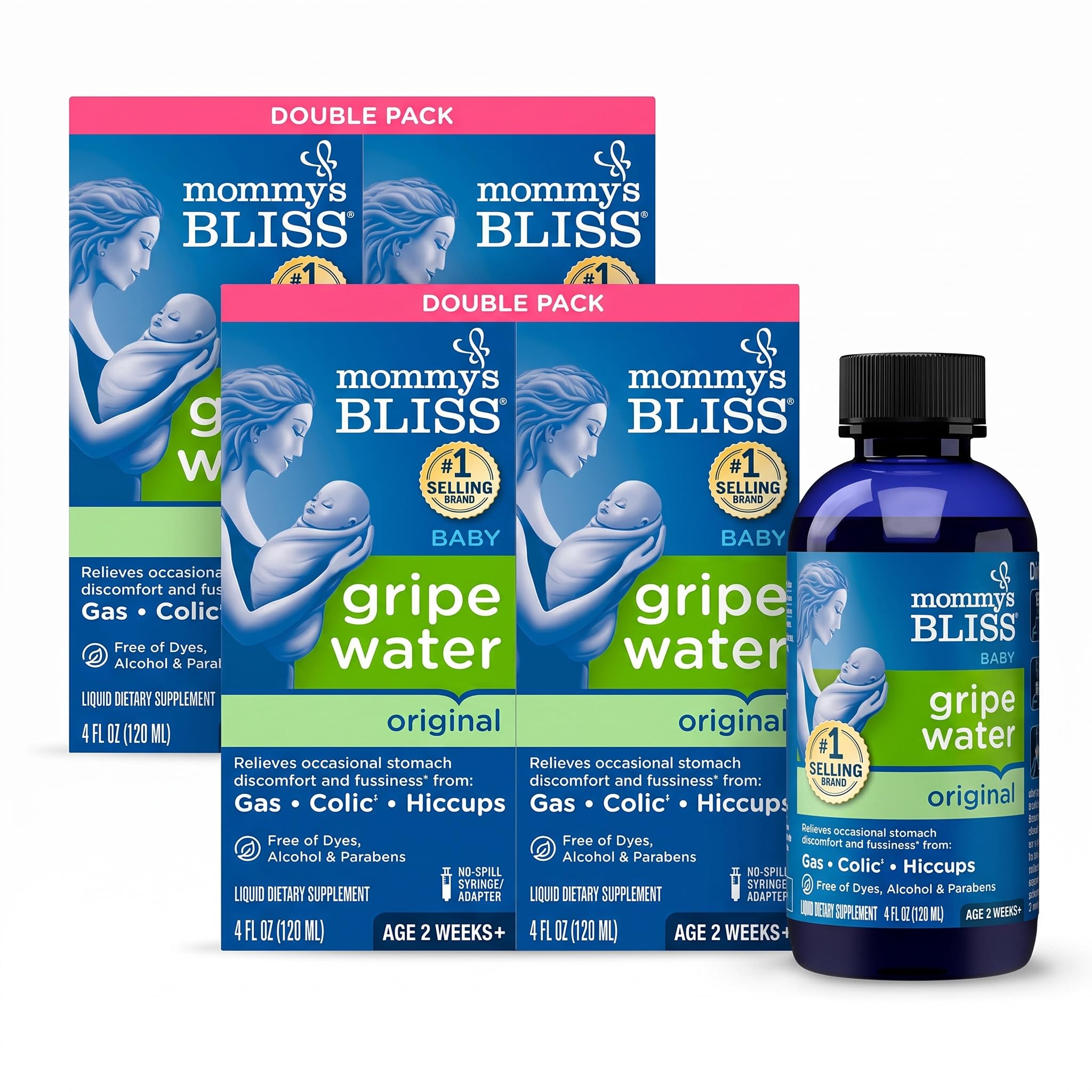
Mommy's Bliss Original Gripe Water

95 /100
Trail Score Outstanding

Key details

Age
2 weeks and up
Dosing
No-spill syringe
Formula
Organic fennel and ginger
Bottle Size
4 fl oz (pack of 4)
Check Price on Amazon

Two weeks is the number that matters here: Mommy's Bliss Original is labeled for babies 2 weeks and older, so it is not the thing to reach for in the first fortnight. Once your baby clears that mark, this is the gripe water we choose for hiccups and fussy evenings. The organic fennel and ginger formula is gentle, and the no-spill syringe is the detail we appreciate most; it lets you place a small dose without wrestling a dropper.

The taste is sweet, and that helps. A baby who turns away from a bitter or medicinal liquid often takes this one, which matters when you are already trying to calm a crying infant. The bottle comes as a four-pack, so one can live in the diaper bag and one can stay by the crib. The formula has no alcohol, parabens, or artificial colors or flavors.

We give it slowly into the cheek rather than squirting it straight back, because gagging is the risk with any liquid for a very young baby. If your baby was premature or has feeding difficulties, ask your pediatrician before the first dose. The sweet taste is not a guarantee, but it is the reason this one is easy to get into a baby who is already upset.

Pros

  • Labeled for babies 2 weeks and older
  • Fennel and ginger formula for hiccups
  • No-spill syringe simplifies dosing

Cons

  • Four-bottle pack is more than some families need
Our verdict

We recommend Mommy's Bliss Original Gripe Water when hiccups and fussy evenings are the pattern; the syringe and two-week age floor make it easy to use.

Check Latest Price
3

Best Sweet-Tasting Newborn Option

Little Remedies Gripe Water

93 /100
Trail Score Outstanding

Key details

Age
Newborns
Formula
Fennel, chamomile, organic agave
Free From
Artificial dyes, gluten, sodium bicarbonate
Bottle Size
4 fl oz
Check Price on Amazon

Little Remedies Gripe Water is the sweeter of our two gripe waters, and sweetness is doing real work here. The base is organic agave, so the liquid goes down more readily than a sharp herbal dropper, and the label says it is safe for newborns. We keep it as the alternative for a baby who will take a sweet liquid when nothing else gets past a clamped mouth.

The formula includes fennel, which the label ties to digestion, plus chamomile for calm. It has no artificial dyes, gluten, or sodium bicarbonate. We noticed the effect most with hiccups: a small dose often settles a spell that has been disrupting sleep. That is a narrow use, but it is a useful one in the first months.

We reach for it when a newborn needs help with hiccups and will accept a sweet spoonful. The effect is not a cure for colic, and it will not solve every fussy stretch; it is a small tool for a specific moment. If your baby has reflux or feeding trouble, talk to your pediatrician before adding a herbal water to the routine.

Pros

  • Safe for newborns on the label
  • Sweet organic agave base
  • Fennel and chamomile formula
  • No artificial dyes or sodium bicarbonate

Cons

  • Bottle can be difficult to open
  • Sticky liquid needs rinsing
Our verdict

Little Remedies is our pick for a newborn who accepts a sweeter gripe water, as long as you can get the bottle open without a struggle.

Check Latest Price
4

Best Once-Daily Probiotic

Culturelle Baby Probiotic Drops

93 /100
Trail Score Outstanding

Key details

Age
0–12 months
Dosing
5 drops once daily
Strains
L. rhamnosus GG and other probiotics
Bottle Size
8.5 ml
Check Price on Amazon

Culturelle's pitch is simplicity: five drops, once a day, for babies from birth to 12 months. That routine is the reason it earns a place here. There is no as-needed decision to make and no measuring a larger syringe in the dark; you add the drops to a spoon, a bottle, or directly into the mouth while breastfeeding, and you are done.

We like the strain story: Lactobacillus rhamnosus GG is a familiar probiotic strain, and the formula is built for occasional tummy troubles and colic. This is a product for a family that wants a daily habit, not a rescue dose for a sudden gas attack.

The other thing we watch is tolerance. Some babies have more diarrhea or reflux when starting a probiotic, so the first few days are not the time to add three other new things. If your baby is already struggling with reflux, start when you can keep an eye on them and stop if the symptoms get worse. For a baby who tolerates it, the once-a-day format is hard to beat.

Pros

  • Once-daily five-drop dose
  • Designed for 0–12 months
  • Can go on spoon, bottle, or breast

Cons

  • Small bottle for the cost
Our verdict

Culturelle suits parents who want a single daily probiotic dose for a baby from birth to 12 months, and we think the simplicity is worth the premium.

Check Latest Price
5

Regularity Support

Mommy's Bliss Baby Probiotic Drops

93 /100
Trail Score Outstanding

Key details

Age
Newborns and up
Dosing
Dropper
Formula
Flavorless probiotic drops
Bottle Size
0.34 fl oz
Check Price on Amazon

Flavorless is the detail that makes Mommy's Bliss Everyday easy to work into a feeding routine. There is no berry taste to fight and no dye, so you can put the drops on a spoon or into a bottle without changing the feed. We see it as a regularity probiotic more than an instant gas rescue: the point is a happier, more predictable tummy over time.

The formula uses a well-researched probiotic strain and is marketed for newborns and up. The bottle is small, which is convenient for a diaper bag but not for the budget; daily use makes it a recurring purchase.

We reach for it when constipation and irregular stools are part of the colic picture, not when you need an immediate calmer. Some babies get more gas or diarrhea when a probiotic is introduced, so start on a day you can watch them and stop if things get worse. It is a daily tool, and it asks for patience.

Pros

  • Flavorless formula
  • Marketed for newborns and up
  • Daily probiotic for regularity

Cons

  • Dropper can be hard to separate and measure
Our verdict

Mommy's Bliss Everyday is the probiotic we reach for when constipation and irregular stools are part of the colic picture.

Check Latest Price
6

Organic Probiotic

Wellements Organic Baby Probiotic

87 /100
Trail Score Excellent

Key details

Dosing
6 drops
Strain
LactoSpore Bacillus coagulans MTCC 5856
Bottle Size
0.25 fl oz
Certification
USDA Organic, Non-GMO
Check Price on Amazon

Wellements puts the certifications first: USDA Organic, Non-GMO Project Verified, Vegan Action Certified, and a formula free of preservatives, artificial colors, and artificial flavors. The dose is six drops, which is a small enough ritual to fold into a feed. For a family that reads labels closely, that combination is the appeal.

The probiotic is LactoSpore Bacillus coagulans MTCC 5856, and the liquid is odorless and tasteless. We appreciate that it does not turn a bottle into a different-tasting feed. The certifications are the reason this one is on the list, not the strain alone.

This is the one we treat as a trial. The colic evidence around this specific strain is thinner than what we see with BioGaia, and some babies show no change at all. We still keep it for families who want an organic probiotic and are willing to give it a fair run, but we do not start here if you need the most studied colic option.

Pros

  • USDA Organic and Non-GMO
  • Six-drop daily dose
  • No preservatives or artificial colors

Cons

  • Small bottle for the price
Our verdict

Wellements is the organic option we keep for families who prioritize certifications, but we treat its effects as gradual and unproven for every baby.

Check Latest Price

How We Tested Colic Drops in Real Nurseries

We started with a shortlist of 14 formulas, filtering out anything with unclear dosing instructions, a dropper that was hard to read, a bottle that seemed oversized for the number of doses inside, or labeling that made side effects and ingredients hard to find. We also compared cost per dose, not just sticker price, because a larger bottle is no bargain if half the serving clings to the dropper.

Over four months, those 14 formulas lived in diaper bags, on nightstands, and on kitchen counters. We used them during 2 a.m. feeds, after burping sessions, through hiccup spells, and across plenty of diaper changes, noting whether each one was easy to shake, draw up, and offer one-handed. We counted drops against the markings, watched for pooling or clumping in the dropper, and recorded whether babies accepted the taste or turned away.

For each formula, we kept a simple log of burps, hiccups, gas, spit-up, stool changes, fussiness, and sleep, which gave us a clearer read on effectiveness and side effects than a single good or bad night. We checked seals and batch information on arrival, noted how the consistency held up after a few weeks, and calculated realistic doses per bottle after accounting for waste. The result is a shortlist built around what made the 3 a.m. routine feel less like a scramble.

How to Choose Colic Drops for a Newborn

Start With the Age Line, Not the Front Label

We put the age field above the front label because several fast simethicone drops in this category carry a three-month manufacturer age, even when the front says newborn. That does not make them bad products; it makes them the wrong purchase for a two-week-old. For the earliest weeks, our picks are BioGaia for day-one use and the two gripe waters labeled for newborns or two weeks and up. If your baby was premature, ask the pediatrician before any product.

Read the dose limit too. A product that is safe at every feeding is not the same as one you can use whenever you like; the label sets the ceiling. When the age and dose lines both fit your baby, the choice gets much simpler.

Match the Format to the Moment

We separate rescue from routine. Gripe water is the as-needed lane: it is the one we reach for when hiccups or a fussy evening is the pattern, and a syringe makes it easier to give a small dose without a fight. Probiotics are the daily lane: BioGaia and Culturelle are designed to be given consistently, and the effect builds over days rather than minutes.

If you are shopping for a fast gas drop, the simethicone category is the right place to look, but check the age field first; several products in this set sit at three months and up. For a newborn, a gripe water labeled for the age is the more practical fast option in our set.

Look at Dose Delivery, Taste, and Additives

A syringe with clear marks is easier at 3 a.m. than a dropper you have to hold steady. The Little Remedies gripe water bottle can be stubborn to open, and the Mommy's Bliss Everyday dropper can be hard to separate from the cap; those small frictions become large with a crying baby. Test the closure before the first middle-of-the-night dose.

Taste matters too. A sweet gripe water like Little Remedies goes down more readily, but it is sticky and needs a rinse. A flavorless probiotic disappears into a bottle. Check the allergen and dye line as well: BioGaia lists no dairy, soy, gluten, sugar, or artificial colors, and Culturelle is built for a once-daily routine.

Buy for the Routine You Actually Have

A four-pack of gripe water is a good deal if you use it at every fussy evening, but it is a commitment if you are still testing whether gripe water helps. A small probiotic bottle is a daily purchase, so the bottle size matters more than the shelf price. We think the right choice is the one you can keep in the place you need it: a syringe by the crib, a dropper by the bottle warmer, or a pack in the diaper bag.

Do not stock three products before you know what your baby tolerates. Start with one format, give it a fair trial, and add a second only if the first leaves a specific gap.

Frequently Asked Questions

Final Verdict

For a newborn, we start with BioGaia Baby. It has the clearest day-one label here and is aimed at colic, which makes it the clearest day-one default while you are still learning what your baby's crying means. Once your baby is past two weeks and hiccups are the trigger, Mommy's Bliss Original Gripe Water is the one we keep close. For a single daily probiotic that lasts through the first year, Culturelle is the simpler routine.