Best Calcium Supplements for Women Over 50 of 2026

Calcium supplements aren't interchangeable. One common form needs a stomach full of acid to break down; another dissolves whether you've eaten or not. For women over 50 that difference matters far more than the big number on the front of the bottle, because absorption — not label milligrams — is what actually protects bone. The right supplement delivers a dose your body can use, in a size you'll still be willing to swallow in month three.

I've kept a calcium bottle on my kitchen counter for years. Over the past five months, my team and I ran 16 different supplements through that same counter — tablets, capsules, chewables, and gummies — taking them with breakfast, with dinner, and on an empty stomach. The pattern that emerged: taste and pill size decide whether you stick with it, sugar content decides whether a gummy is really a supplement or a candy, and per-serving cost means nothing if the serving is four horse pills. The picks below are the ones that held up — on labeling, on cost, and on whether we actually finished the bottle.

1

Best Overall

Caltrate Minis 600 + D3

96 /100
Trail Score Outstanding

Key details

Tablet Count
150 mini tablets
Added Minerals
Zinc, copper, manganese
Calcium Per Serving
600 mg (2 mini tablets)
Vitamin D3 Per Serving
40 mcg
Check Price on Amazon

Calcium bottles get abandoned for a boring reason: the pills are enormous. The Minis are the answer to that, and it's why they top this list. Caltrate keeps them small enough to take with an ordinary mouthful of water, and each pair of tablets carries 600 mg of calcium, 40 mcg of vitamin D3, plus zinc, copper and manganese. In a category where the best supplement is the one you actually finish, the tablet you don't dread is the whole argument.

The dose needs explaining, because the name oversells it. That 600 refers to two mini tablets, not one. A full 1,200 mg day from the bottle alone is four minis across two meals — which is roughly how calcium absorbs best anyway, since your body handles somewhere around 500 to 600 mg at a time and wastes more above that. The split isn't a compromise here; it's the right shape.

The vitamin D3 load is the heaviest of any pick in this guide at 40 mcg (1,600 IU). That sits well under the adult upper limit, but if you already take a D supplement, add the numbers before you buy. The three trace minerals earn their place too: zinc, copper and manganese are all part of the bone-health picture, and you'd otherwise be buying a second bottle to get them.

Two things to know before you commit. Calcium carbonate needs stomach acid, so take the pair with a meal; if you're on a proton-pump inhibitor for reflux, go citrate instead — the Petites below. And the bottle costs more per milligram than the big value tablets. You're paying for the size, and for a great many women over 50 that is the difference between a habit and a half-empty bottle in the cupboard.

Pros

  • Small tablets are the easiest swallow here
  • 600 mg per two-tablet dose suits absorption
  • Includes zinc, copper and manganese
  • High vitamin D3 at 40 mcg per dose

Cons

  • Four tablets for a full 1,200 mg day
  • Costs more per milligram than big-tablet bottles
Our verdict

The calcium supplement we recommend first for women over 50: small coated tablets that go down easily, with a sensible 600 mg dose, a high dose of D3 and zinc, copper and manganese alongside.
Check Latest Price
2

Best for Once-Daily Dosing

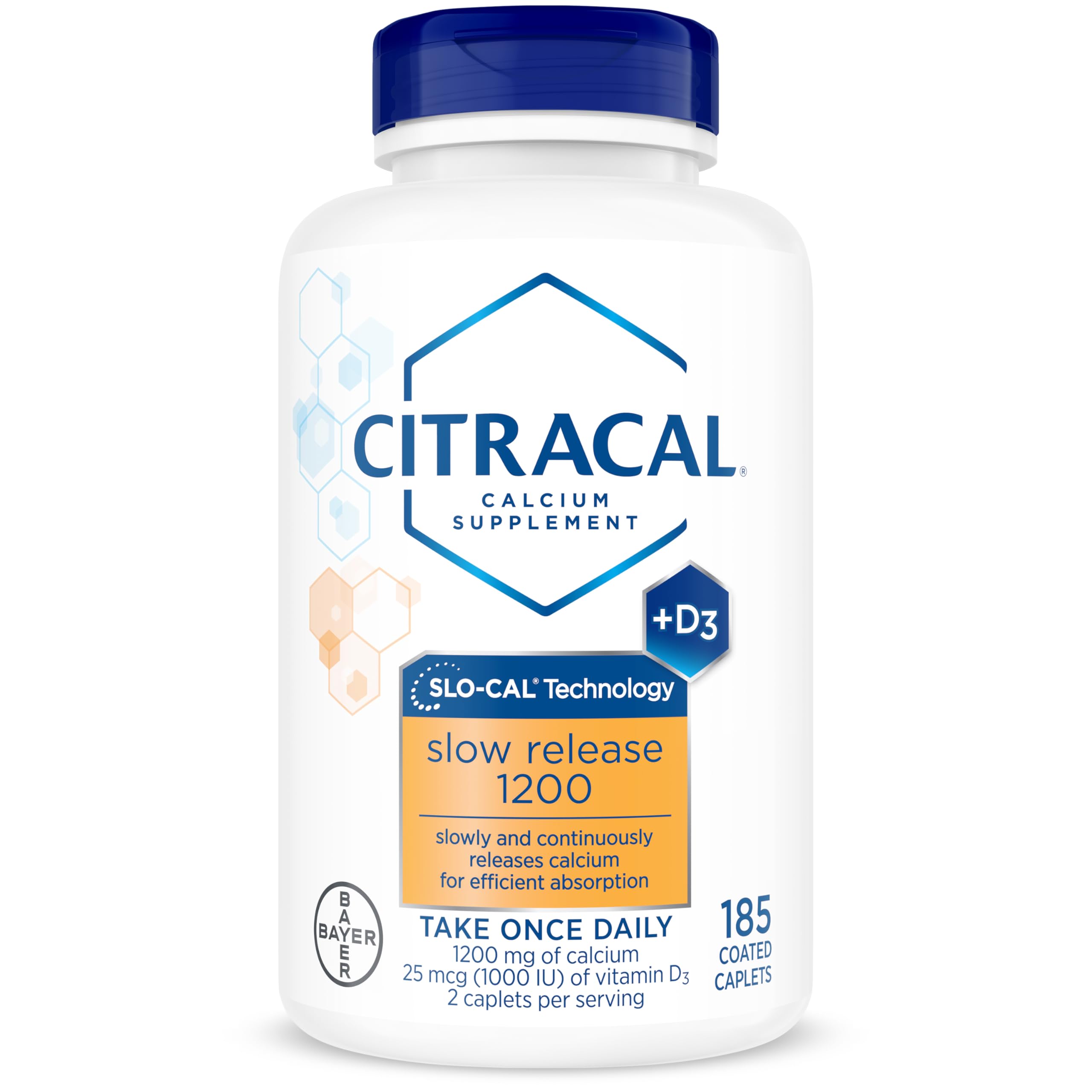
Citracal Slow Release 1200

95 /100
Trail Score Outstanding

Key details

Tablet Count
185 caplets
Added Minerals
Magnesium
Calcium Per Serving
1,200 mg
Vitamin D3 Per Serving
25 mcg (1000 IU)
Check Price on Amazon

One dose, once a day. That's the entire pitch, and it's a good one: a serving carries 1,200 mg of calcium — part carbonate, part citrate — along with 25 mcg (1000 IU) of vitamin D3 and magnesium, all in two caplets you take together. Nothing to remember at lunch, nothing rattling around in a bag.

We understand the appeal. The slow-release coating meters the calcium out over hours instead of dropping 1,200 mg into your stomach at once, which is closer to how your body prefers to receive it, and the citrate portion means the dose doesn't have to be timed around a meal. The trade-off is the caplet itself: to fit a full day's calcium into two, each one has to be substantial, and a hard-edged caplet that size takes commitment to swallow. It's also why you can't score them — break the coating and the slow release is gone.

So the calculation is honest. If your problem is remembering a second dose, this solves it cleanly and the size is the price. If your problem is pills in general, it solves nothing: take the once-daily convenience off the table and look at the Minis or the Petites, both of which trade dose frequency for something you can actually get down.

Pros

  • 1,200 mg calcium in a single daily dose
  • Slow-release coating spreads absorption
  • Citrate and carbonate blend with magnesium

Cons

  • Large, hard-edged caplet
Our verdict

The one to buy if remembering a midday dose is what derails you: 1,200 mg of calcium, D3 and magnesium in two caplets taken once, with a tablet big enough to give some women pause.

Check Latest Price
3

Best Small Citrate Caplet

Citracal Petites

95 /100
Trail Score Outstanding

Key details

Form
Calcium citrate
Tablet Count
375 caplets
Calcium Per Serving
400 mg
Vitamin D3 Per Serving
12.5 mcg (500 IU)
Check Price on Amazon

'Petites' is doing a lot of work on this label. These are coated caplets, smaller than Citracal's maximum-strength tablets and easier to get down than most calcium, but anyone picturing a tiny pill should recalibrate before ordering. What they are, reliably, is the most manageable route to calcium citrate — the form you can take with or without food.

That food question is the reason to care about citrate in the first place. Carbonate needs stomach acid to dissolve, so it has to go with a meal; citrate doesn't, which matters if you're on a reflux medication or eat breakfast at odd hours. It's also the gentler of the two forms on a stomach with opinions.

The arithmetic is where Petites gives ground. A serving is 400 mg of calcium and 12.5 mcg (500 IU) of vitamin D3, so a full 1,200 mg day means three servings, and a 375-count bottle empties faster than the number suggests. What we noticed over a few weeks is how little there is to plan around — no meal to catch, no chalky aftertaste to wash away. For a stomach that has rejected other calcium, that's worth the counting.

Pros

  • Calcium citrate works with or without food
  • Smaller, coated caplet than most citrate
  • No chalky aftertaste
  • 375-count bottle runs for months

Cons

  • Bigger than the name suggests
Our verdict

Our pick for anyone who needs calcium citrate and a caplet easier to get down than the big citrate tablets, even if the word petite is doing more advertising than describing.

Check Latest Price
4

Best Gummy

Vitafusion Calcium Gummies

95 /100
Trail Score Outstanding

Key details

Form
Gummy
Bottle Supply
50 days
Calcium Per Serving
500 mg (2 gummies)
Check Price on Amazon

The first thing to know about these is that they're sweet. Vitafusion coats its calcium gummies in sugar and flavors them fruit-and-cream, which is exactly why some women finish the bottle and exactly why others put it straight back on the shelf.

Mechanically they're simple: two gummies deliver 500 mg of calcium with vitamin D3 alongside, and you chew them. No water, no tablet, no timing to work out. For anyone who has choked down a calcium pill and quietly stopped taking it, that's not a small thing — and the 100-count bottle runs 50 days at the label dose.

The limits are plain. There's no magnesium, zinc or copper in these — just calcium and D3 — so if your clinician has suggested the wider mineral mix, this isn't the bottle. And that sweet coating is real sugar, which matters if you're counting it or watching your blood sugar.

Where these earn their place is as the exit ramp from pills. A woman with a cupboard full of untouched calcium tablets is worse off than one who takes two gummies after dinner, and 500 mg is a sensible dose to take twice a day. If the alternative on the table is nothing, buy these. If it's a pill you're willing to swallow, buy the Minis and skip the sugar.

Pros

  • No pills, water or timing to manage
  • 500 mg calcium plus D3 per two gummies
  • Gluten free, dairy free, no synthetic dyes

Cons

  • Sugared coating adds sugar to the day
  • No magnesium, zinc or copper
Our verdict

The pick for anyone who won't take pills: two fruit-and-cream gummies deliver 500 mg of calcium and D3, with a sugared coating as the price of actually finishing the bottle.

Check Latest Price
5

Best Value

Nature Made Calcium 600 + D3

95 /100
Trail Score Outstanding

Key details

Tablet Count
220 tablets
Calcium Per Tablet
600 mg
Third-party Verified
USP Verified
Check Price on Amazon

Per tablet, this is the cheapest calcium-plus-D3 in the guide, and it's the bottle we point to when someone wants a simple, trustworthy supplement and no decisions. Each tablet carries 600 mg of calcium with vitamin D3, and the whole thing is USP Verified — an independent check that what's printed on the label is what's in the tablet, which only one other pick here can claim.

Two hundred and twenty tablets go a long way. One with breakfast and one with dinner puts you at 1,200 mg and sets you up for months, so the value story isn't the shelf price alone — it's cost per dose, which is among the lowest in this group.

The compromise is the tablet — large, dense, and the single reason this isn't our top pick for women over 50. If swallowing has never given you trouble, there's no better-value bottle on this page. If it has, the Caltrate Minis are the same idea in a shape you'll keep taking.

Pros

  • USP Verified, so label matches contents
  • 600 mg calcium plus D3 per tablet
  • Lowest cost per tablet of these bottles

Cons

  • Large, dense tablet
Our verdict

The value buy: 220 USP-verified tablets with 600 mg of calcium and D3 each, at the lowest cost per tablet among the calcium-plus-D3 bottles here, provided you can swallow a big pill.

Check Latest Price
6

Fewest Daily Doses

Nature's Bounty Calcium 1200 Softgels

93 /100
Trail Score Outstanding

Key details

Form
Softgel
Count
220 softgels
Calcium Per Serving
1,200 mg
Vitamin D3 Per Softgel
1,000 IU
Check Price on Amazon

Most calcium arrives as a hard tablet. This one is a softgel, and the format does the work: Nature's Bounty puts 1,200 mg of calcium in a single serving, more than any other pick here, with 1,000 IU of vitamin D3 in every softgel.

That's the appeal, and it's a real one — fewer doses, fewer things to remember, and a soft capsule rather than a chalky tablet to get down. Read the serving line before you buy, though. The calcium figure is quoted per serving while the vitamin D is quoted per softgel, so check how many softgels make a serving rather than assuming one is a full dose.

Two hundred and twenty softgels is a serious bottle, and the formula is gluten free and sugar free with nothing decorative added. The number to keep in mind is that 1,200 mg in one hit leaves little room for the calcium in your yogurt and your greens; if you already eat well, a smaller dose taken twice may suit you better than the biggest number on the shelf.

Pros

  • 1,200 mg calcium per serving, the highest here
  • 1,000 IU of D3 in each softgel
  • Gluten free and sugar free

Cons

  • 1,200 mg at once leaves little room for dietary calcium
Our verdict

For the shortest dosing routine here: 1,200 mg of calcium per serving with 1,000 IU of D3 in each softgel, though the serving size and your dietary calcium both deserve a check first.

Check Latest Price
7

Clean-Label Citrate

Pure Encapsulations Calcium Citrate

95 /100
Trail Score Outstanding

Key details

Form
Calcium citrate capsule
Count
180 capsules
Free From
Common allergens, GMOs
Check Price on Amazon

Read the ingredient line and there's almost nothing there: calcium citrate, a capsule, and nothing else of note — no fillers, no common allergens, no GMOs. Pure Encapsulations sells a short list, and for something you take every day for years, that's a reasonable thing to want.

The capsule is the other half of the appeal. It goes down easily, and citrate doesn't need a meal to dissolve, which is where the gentleness on a difficult stomach comes from. There's no vitamin D3 in the bottle, so pair it with whatever D supplement you already trust — a feature if you take a D3 drop or a multivitamin with D, an extra purchase if you don't.

What you give up is convenience. This is a bottle you have to think about, counting capsules against your day rather than taking one tablet with breakfast, and two capsules won't get most women near a full daily amount. For a reader who reacts to everything and wants the plainest possible citrate, that trade is still worth making.

Pros

  • Calcium citrate in a smooth capsule
  • No fillers, common allergens or GMOs
  • Gentle on sensitive stomachs

Cons

  • Highest price of any pick here
Our verdict

For a sensitive stomach and a short ingredient list: a calcium citrate capsule with no fillers, gentle enough to take daily, at the highest price in this guide.

Check Latest Price
8

Calcium with Magnesium

Nature Made Calcium Magnesium Zinc

96 /100
Trail Score Outstanding

Key details

Dose
1 tablet up to 3 times daily
Minerals
Calcium, magnesium, zinc, D3
Tablet Count
300 tablets
Third-party Verified
USP Verified
Check Price on Amazon

One tablet up to three times a day, with water and a meal. That instruction on the back of the bottle tells you most of what you need to know: this is a calcium carbonate supplement designed to be split across the day, with magnesium, zinc and vitamin D3 riding along in the same tablet.

Three hundred tablets is a long supply, and the formula is gluten free with no synthetic dyes or artificial flavors. It also carries the USP Verified mark — the same independent check we liked on Nature Made's plain calcium bottle, and a reassurance that the minerals on the front are actually in there.

Magnesium and zinc are the reason to choose this over a plain calcium tablet. Magnesium is what women most often add alongside calcium, for sleep and for muscle cramps, and having it in the same pill saves a bottle and a swallow. What the label doesn't spell out is how much calcium each tablet carries, so read the supplement panel before you assume one tablet is a full dose.

What we like is the routine it slots into: a tablet with breakfast, one with dinner, both with food, and the magnesium and zinc arriving in the same swallow. If you already take a separate magnesium at night, that advantage disappears — buy the plain calcium and keep your own magnesium.

Pros

  • Calcium, magnesium, zinc and D3 in one tablet
  • USP Verified
  • 300 tablets per bottle
  • Flexible one-to-three-times-daily dosing

Cons

  • Dosing up to three times a day
Our verdict

For one bottle instead of three: calcium, magnesium, zinc and D3 in a USP-verified tablet you take with meals, with a split-up daily dose that suits absorption.

Check Latest Price

How We Chose and Tested Calcium Supplements

We started by pulling roughly 40 options off the shelf — drugstore brands, practitioner-only lines, gummies, and powders — then filtered for a third-party testing seal, a stated form of calcium (citrate, carbonate, or a blend), and a serving that supplied at least 300 mg of elemental calcium without demanding four tablets to get there. That cut the list to 16, which we bought at retail like anyone else would and logged by lot number.

Testing ran five months. Every supplement went into a real routine: taken with breakfast, with dinner, and on an empty stomach on alternating weeks, so we could notice what our stomachs did afterward — bloating, cramping, constipation — and how long it lasted. We measured each pill with calipers and swallowed it with a fixed four ounces of water, noting whether it went down in one try, needed a second gulp, or had to be broken in half. Chewables and gummies were tasted twice: once fresh out of the bottle and again after eight weeks open on the counter, since texture changes fast once air gets in.

For effectiveness we did the elemental calcium math rather than trusting the compound weight on the label, tracked whether each one included vitamin D and at what dose, and calculated cost per 500 mg of elemental calcium instead of cost per bottle. Sugar got counted too — several gummies carried 4 to 6 grams per serving, which is closer to dessert than supplement. We also read each label the way a skeptical shopper should: seal, lot number, and a supplement facts panel you can parse without a magnifier.

How to Choose a Calcium Supplement After 50

Citrate or carbonate: start with your stomach

Calcium carbonate is the cheaper, denser form, and it needs stomach acid to dissolve, so it goes with a meal. Calcium citrate dissolves without acid, which makes it the safer choice if you take a reflux medication, have had gastric surgery, or find carbonate leaves you constipated. If you eat breakfast in the car and take your pills dry, buy citrate. If you sit down to three meals a day, carbonate is fine and usually cheaper. The trap worth knowing: swallowing a carbonate tablet on an empty stomach wastes most of the dose.

The number on the front is not the number per pill

Labels describe servings, not tablets, and calcium is where that bites. Caltrate's Minis put 600 mg in two tablets; Citracal's Petites put 400 mg in a serving; a 1,200 mg bottle may spread that figure across two caplets. Read the serving line before you compare prices, or you're comparing different amounts of calcium.

Then do the day's math. Women over 50 generally need around 1,200 mg of calcium a day from food and supplements combined, and absorption gets less efficient above roughly 500 to 600 mg at a time. Two smaller doses beat one large one, which is why a 600 mg tablet taken twice is better designed than a 1,200 mg tablet taken once.

Pill size decides more than any label claim

Calcium is a bulky mineral. A 600 mg dose has to go somewhere, and it usually means a tablet with some heft — the most common reason a calcium bottle goes unfinished. Smaller tablets taken more often, and coated caplets, both help. Two traps: 'mini' and 'petite' are relative words rather than measurements, so check the milligrams per tablet; and a slow-release tablet can't be halved, because breaking the coating releases the whole dose at once.

Check the vitamin D3 number, not just the word

Every pick here includes vitamin D3, because vitamin D is what lets your body absorb the calcium you paid for. What varies is how much: these picks run from 12.5 mcg (500 IU) per serving to 40 mcg (1,600 IU). If you already take a D supplement or a multivitamin with D, add the numbers before you buy. The adult upper limit is 100 mcg (4,000 IU) a day, and it's easier to pass than it sounds when two bottles both contain D.

What the extras are worth paying for

Magnesium, zinc, copper and manganese turn up on bone-health labels, and while none of them stands in for calcium and D3, a formula that includes them saves a second bottle — magnesium in particular is the mineral women most often add for sleep and muscle cramps. We also look for USP Verified, which means an independent lab has checked that the tablet contains what the label claims; two picks here carry it. After that, cost per day beats shelf price every time.

Frequently Asked Questions

Final Verdict

We hand over the Caltrate Minis first. For a woman over 50 who needs calcium and vitamin D3 and has to swallow the thing every day, the combination of a genuinely small tablet, a 600 mg dose that suits absorption, 40 mcg of D3 and three supporting minerals is the easiest routine on this page to keep.

Change the pick when your requirement changes. On a reflux medication or eating at odd hours, go citrate: the Petites if size matters, the Slow Release if one daily dose is worth a bigger tablet. If pills are the obstacle, the gummies are the honest answer, sugar and all.