Best Azelaic Acid Serums of 2026

Azelaic acid does two jobs that rarely share a bottle: it fades the brown marks that linger long after a breakout heals, and it calms the redness that shows up before the next one. It's also mild enough for most skin types to use twice a day, which is why it has quietly become the ingredient people land on after the harsher actives have burned them out. For you, that means a good serum evens out tone over a few weeks without wrecking your barrier — and a bad one leaves you greasy, itchy, or reaching for a heavier moisturizer by noon.

Here's what nobody tells a first-time buyer: the percentage printed on the front isn't the whole story. A moderate strength in a soothing, fragrance-free base often treats skin better than a high one cut with alcohol and perfume. We spent six months with 12 azelaic acid serums — under sunscreen, under makeup, through a humid stretch and a dry one — and the ones that earned a spot below share a few habits, from sinking in fast to never announcing themselves with a sting. What follows is built for people who want the fading and the calming without a red, flaky week of adjustment.

1

Best Overall

Anua Azelaic Acid 10 Hyaluron Serum

91 /100
Trail Score Outstanding

Key details

Size
1.01 fl oz
Formula
Green-tinted watery serum
Azelaic Acid
10%
Also Includes
Hyaluronic acid, panthenol, cica
Check Price on Amazon

Anua's serum arrives as a pale green, almost watery liquid — the tint comes from blue tansy oil rather than dye — and it sinks in before you have capped the bottle. That combination is why it is our top pick. The 10% azelaic acid is what goes after dark spots and redness, but the three weights of hyaluronic acid, panthenol, and a cica-based calming complex around it turn a leave-on acid into a hydrating step. It leaves nothing tacky behind for sunscreen or foundation to fight with.

The directions are the most useful thing on the box. Anua tells you to begin with one or two drops, once or twice a week, and build toward twice daily — a slower ramp than most serums ask for, and a fair admission that the first weeks of azelaic acid can sting. We followed that when we used it: two drops on a dry face, moisturizer over the top, and no retinoid or exfoliant in the same routine until the skin had settled.

Reactive skin is where any 10% acid can turn, so patch test along the jaw for a few nights before going full-face, and hold off if you are already using a prescription retinoid. The bottle is small next to the cream formats here, though at two drops a use it lasts longer than the ounce suggests. What it does better than the cheaper picks is disappear: it is the one we reach for on a morning when there is makeup and SPF to follow.

Pros

  • Layers cleanly under sunscreen and makeup
  • Hyaluronic acid, panthenol, and cica cushion the acid
  • Clear ramp-up directions for first-time users
  • Watery texture suits redness-prone skin

Cons

  • Costs more per ounce than the budget picks
Our verdict

If you want one bottle for redness and dark spots that you will actually wear every morning, the Anua is the one we hand over.

Check Latest Price
2

Best Budget

The Ordinary Azelaic Acid Suspension 10%

91 /100
Trail Score Outstanding

Key details

Size
1.06 oz
Formula
Cream suspension
Shelf Life
12 months after opening
Azelaic Acid
10%
Check Price on Amazon

It is the least expensive thing in this guide, and it is not a serum at all — it is a thick, velvety cream suspension that sits on skin the way a night cream does. The Ordinary built its reputation on exactly that formula: a short ingredient list, a named percentage, and a tube that does not ask you to commit much to find out whether azelaic acid suits you.

Two things are worth knowing before the first application. The directions are specific about keeping it away from the eye contour, the eyes, and the mouth, and about wearing sunscreen during the day. And because it is a cream, it goes underneath your moisturizer rather than on top of it, which makes it the easiest of these to slot into a routine that already has a moisturizer you like.

Where it earns its place is as a trial. We treat it that way: if you have never used azelaic acid, this is the tube to find out with, because the texture is pleasant, an abandoned experiment costs almost nothing, and the formula is aimed squarely at the concerns that bring most people to the ingredient — uneven tone, blemishes, rough texture, rosacea-prone redness. What it will not do is feel like a modern serum. It is a cream, and it behaves like one.

Pros

  • Lowest price in this guide
  • Cream texture suits a nighttime routine
  • Written for daily morning and evening use
  • Aimed at uneven tone and rosacea-prone redness

Cons

  • Small tube that often arrives part-filled
Our verdict

The cheapest way to find out whether azelaic acid agrees with your skin, and a solid cream in its own right.

Check Latest Price
3

Best Cream Formula

Good Molecules 10% Azelaic Acid Treatment

89 /100
Trail Score Excellent

Key details

Size
1.7 fl oz
Formula
Buffered cream
Skin Types
All, including sensitive
Azelaic Acid
10%
Check Price on Amazon

Good Molecules puts a number on its pitch: the brand's own consumer testing found that 90% of users saw post-acne spots fade and noticed less facial redness. That is a brand study rather than an independent one, so treat it as a reason to try rather than proof — but the formula behind it is a buffered 10% azelaic cream, which is a more comfortable proposition than a straight acid suspension.

Of the cream-format options here, this is the one we point to first. It is 1.7 ounces, more product than any other cream in this group, it is unscented, and it absorbs quickly enough to sit under sunscreen in the morning. The 10% is buffered rather than raw, which is roughly what the twice-daily directions imply: a formula built to be tolerated rather than to make a point of its strength.

The one thing to set expectations on is texture. The cream can feel slightly gritty as you spread it, though it smooths out as it dries and leaves nothing behind under moisturizer. Give it a month before you judge the marks. Post-blemish fading is a slow effect, and a fortnight is not enough time to tell whether any of these is working.

Pros

  • 1.7 oz, the most cream-format product here
  • Buffered 10% built for twice-daily use
  • Unscented and quick to absorb
  • Dermatologist tested and non-comedogenic

Cons

  • Can sting during the first week of use
Our verdict

A big, unscented cream that makes twice-daily azelaic easy, and the best value in a cream texture here.

Check Latest Price
4

Best for Rosacea-Prone Redness

Cos De BAHA Azelaic Acid 10% Serum

88 /100
Trail Score Excellent

Key details

Base
Aloe leaf extract
Size
1 fl oz
Azelaic Acid
10%
Also Includes
Niacinamide, panthenol, sodium hyaluronate
Check Price on Amazon

Of everything here, this is the one we name when the redness behaves more like rosacea flushing than a post-blemish mark. The base is aloe leaf extract rather than water, which gives it a cool, slippery feel going on, and the formula pairs 10% azelaic acid with niacinamide and panthenol. It is the pick we reach for when someone describes stinging cheeks rather than a spot that is slowly fading.

The supporting list is longer than most: propylene glycol, propanediol, and sodium hyaluronate for hydration, plus green tea, bitter melon, elderflower, and edelweiss extracts. None of that is what does the work — the azelaic is — but it explains why the serum feels moisturizing rather than tight, and why it manages to be fragrance-free without smelling of much at all. It is light enough to layer under a moisturizer and dries down without stickiness.

Patch test it like any 10% acid and build from alternate nights to twice daily over a couple of weeks. The dropper is the part we like most: two or three drops are easy to control, and the formula spreads further than its consistency suggests, so a small bottle goes a long way. For redness that arrives with heat and flushing rather than as an old blemish, this is the more targeted choice in the group.

Pros

  • Aloe leaf base feels cooling on angry skin
  • Fragrance-free and genuinely hydrating
  • Aimed at rosacea-type redness
  • Dropper gives control over two or three drops

Cons

  • Can sting or rash on very reactive skin
Our verdict

The pick for flushing, rosacea-type redness, with an aloe base that makes 10% azelaic feel soothing rather than sharp.

Check Latest Price
5

Best Multi-Active

Naturium Azelaic Topical Acid 10% Jumbo

89 /100
Trail Score Excellent

Key details

Use
1-2 drops, AM and PM
Size
2 oz
Azelaic Acid
10% glycinated complex
Also Includes
Niacinamide, vitamin C, coffee seed extract
Check Price on Amazon

Read the back of the Naturium bottle and you will notice the 10% refers to a glycinated azelaic acid complex, not free azelaic acid. That is worth knowing before you compare it with the serums here that list the acid itself, because a derivative is a different molecule and a 10% claim on one does not mean the same thing as a 10% claim on the other. It is still a serious azelaic product. It is just not a like-for-like swap.

The rest of the formula is where the value sits: niacinamide, vitamin C, and coffee seed extract alongside the azelaic, with the brand citing an eight-week clinical study for exfoliation, redness, and tone. Naturium advises a patch test first, then one to two pea-sized drops morning and evening. We found the serum thin enough to disappear under moisturizer and sunscreen, which is the main thing a morning active has to do.

It is also the jumbo — two ounces where most of these are one — so a twice-daily habit lasts roughly twice as long as the smaller bottles here. The trade-off is the smell: the formula has a sour, faintly vitamin-C note that lingers for a minute after application, and it is the one thing we mind about it.

Where it earns its spot is the combination step. If the alternative is buying a niacinamide serum and a vitamin C serum separately, this collapses both into the azelaic and does it in a texture that sits well under makeup. If you want to know exactly what your azelaic percentage means, the free-acid formulas above are the cleaner comparison.

Pros

  • Azelaic plus niacinamide, vitamin C, and coffee seed
  • Two ounces, twice the size of most here
  • Layers well under makeup and sunscreen
  • Brand cites an eight-week clinical study

Cons

  • Noticeable sour smell after application
Our verdict

The one-step pick if you want azelaic, niacinamide, and vitamin C together, in a two-ounce bottle that lasts.

Check Latest Price
6

Best for Congested Skin

Paula's Choice 10% Azelaic Acid Booster

88 /100
Trail Score Excellent

Key details

Size
1.06 oz
Formula
Oil-free, fragrance-free
Azelaic Acid
10%
Also Includes
Salicylic acid (BHA)
Check Price on Amazon

Paula's Choice pairs its 10% azelaic acid with salicylic acid, which is the reason this one earns a place even at the top of the price range. The directions suggest using it alone or adding a couple of drops to your moisturizer twice daily — a dilution trick worth knowing if your skin has objected to azelaic before.

The BHA is doing specific work. Salicylic acid gets into pores, which is why this is the pick for blackheads and the rough, bumpy texture that comes with congested skin rather than for redness alone. The azelaic handles the tone side — dark spots, post-blemish marks, general dullness — and the formula is oil-free and fragrance-free, so nothing else in it is competing for your skin's attention.

Texture-wise it is a light cream-gel that spreads a long way and absorbs without a greasy finish. Mixing it into moisturizer is the version we prefer in winter, when a standalone acid layer feels like one step too many; used alone, it is light enough for a morning routine as long as sunscreen follows.

Whether it justifies the money depends on what you are treating. For redness alone, the cheaper picks here do the same job. For skin that breaks out and marks, where the alternative is buying a BHA and an azelaic separately, this collapses them into one step — and that is the case where the premium pays for itself.

Pros

  • Azelaic plus salicylic acid for congested skin
  • Fragrance-free and oil-free
  • Can be mixed into moisturizer
  • Targets dark spots and redness as well as pores

Cons

  • Small bottle for the price
Our verdict

The pick when blackheads and texture matter as much as redness — azelaic and salicylic acid in one fragrance-free step.

Check Latest Price
7

Best Bulk Buy

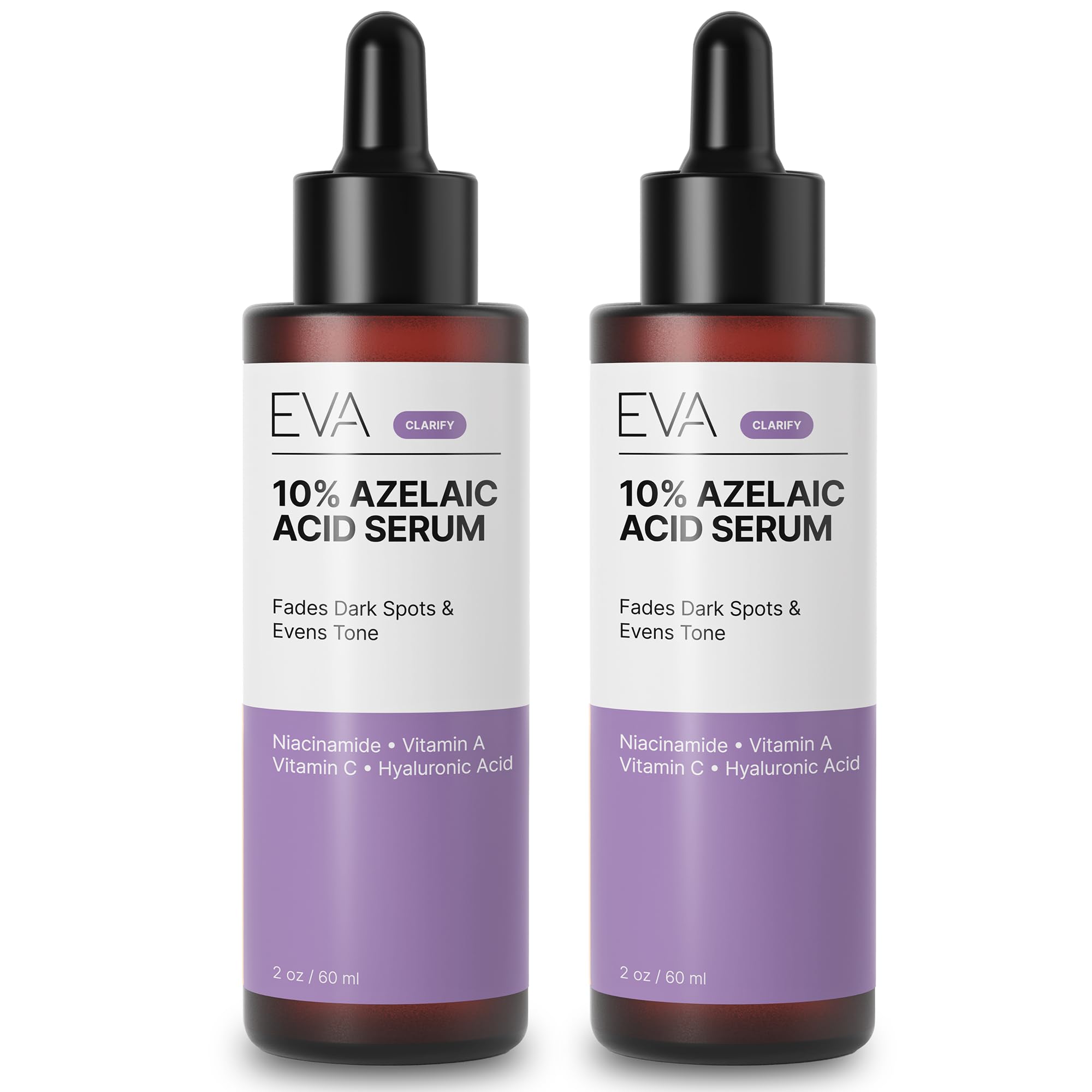
Eva Naturals Azelaic Acid 10% Serum

88 /100
Trail Score Excellent

Key details

Size
2 oz, 2 pack
Free From
Parabens and sulfates
Azelaic Acid
10%
Also Includes
Niacinamide, hyaluronic acid
Check Price on Amazon

Eva Naturals sells this as a two-pack of two-ounce bottles, which is four ounces of 10% azelaic serum in total — more product than anything else in this guide by a wide margin. The formula adds niacinamide and hyaluronic acid to the azelaic and describes itself as lightweight and suitable for all skin types, including sensitive skin.

That volume is the whole argument. This is the one to buy if you already know azelaic acid works for you and you would rather not think about reordering, or if you want to use it generously on your face and neck without watching the bottle. The finish helps: it is non-greasy, absorbs quickly, and layers under moisturizer without the slip that makes some serums difficult to follow with sunscreen.

Where it sits against the rest is elegance rather than results. It is thinner than the creams here and less refined than the Anua, but we found it does not sit heavily and does not ask anything of your routine, which is why it is the one that gets used on rushed mornings. Four ounces for roughly what a single small bottle costs elsewhere is the reason it is on this list.

Pros

  • Four ounces across two bottles, the most product here
  • Non-greasy and quick to absorb
  • Niacinamide and hyaluronic acid alongside the azelaic
  • Free from parabens and sulfates

Cons

  • Noticeably scented
  • Can burn on sensitive skin
Our verdict

Four ounces of fast-absorbing 10% serum with niacinamide — the pick if you go through bottles quickly.

Check Latest Price
8

Sun Spots and Fine Lines

Sesderma AZELAC RU Liposomal Serum

93 /100
Trail Score Outstanding

Key details

Size
1.0 fl oz
Format
Liposomal serum
Skin Types
Dry, oily, combination
Also Includes
Retinol, vitamin C
Check Price on Amazon

Sesderma's AZELAC RU is the most expensive product here, and it is the only one that treats azelaic acid as one ingredient among several: the formula also carries retinol and vitamin C, which puts it in a different category from the single-active serums above. If you are shopping for a straightforward azelaic serum, this is not it.

What it is instead is a hyperpigmentation serum aimed at sun spots and age spots, with a liposomal delivery claim and daily use for dry, oily, or combination skin. The retinol and vitamin C mean it is doing three jobs at once — tone, texture, and fine lines — which is either exactly what you want from one bottle or exactly what you do not, depending on how many actives your skin already tolerates.

Here is the thing we keep coming back to: the listing never states an azelaic percentage. Every other pick here tells you it is 10%; this one tells you the acid is in there and leaves it at that. That does not make it a bad formula — the ingredient list is serious and the bottle is aimed at a real problem — but it makes it a hard recommendation for someone who wants to know what they are applying.

Buy it if you want one bottle for sun spots and fine lines together and you are not already using a retinol or a strong vitamin C. If you are, adding this on top is how routines end up overstacked: pick one and give it a season. Everyone else should start with a formula that names its percentage.

Pros

  • Combines azelaic acid with retinol and vitamin C
  • Aimed at sun spots, age spots, and hyperpigmentation
  • Suited to dry, oily, or combination skin

Cons

  • Does not state an azelaic percentage
  • Retinol and vitamin C rule out stacking other actives
Our verdict

The premium one-bottle option for sun spots and fine lines, provided you are not already using a retinol or vitamin C.

Check Latest Price

How We Tested the Azelaic Acid Serums

We bought every bottle ourselves and started with the label rather than the marketing. Formulas that listed their azelaic acid percentage and kept fragrance and drying alcohol out of the top of the ingredient deck made the first cut; anything that buried the active beneath perfume was set aside. That narrowed roughly 40 candidates to 12, which we tested over six months. Each serum got its own solo stretch of at least two weeks, so a fresh breakout or a fading patch could be traced to one bottle instead of a shelf of them.

Testing happened where skin actually happens: at 7 a.m. before sunscreen and foundation, at night after cleansing, on a sticky afternoon when everything felt like it was sliding off, and during a dry spell when the whole panel's cheeks were tight. We watched the first 60 seconds after application — whether the serum sank in or sat on top of the skin, whether it left a shine that made makeup migrate, whether it needed a moisturizer over it or held fine alone. Then we layered SPF on top and checked for pilling.

Week by week we photographed the same cheek and jaw in the same window light and compared the frames side by side, and we logged every tingle, itch, and flush in a shared note so we could tell a brief adjustment from genuine irritation. Because so many readers ask about scent, we noted which serums smelled of nothing and which carried a perfume that lingered. We also counted pumps, tracked how far each bottle actually went, and flagged the ones whose packaging spat out more than a face needs — the quiet reason a cheap serum stops being good value.

How to Choose an Azelaic Acid Serum

Read the label: 10% of what?

Almost every serum here sits at 10%, but that number does not always describe the same thing. The Ordinary, Anua, Good Molecules, Cos De BAHA, Eva Naturals, and Paula's Choice list azelaic acid itself. Naturium's 10% refers to a glycinated azelaic complex, and Sesderma does not state a percentage at all.

A derivative is a different molecule, so a 10% complex and 10% free acid should not be treated as interchangeable. If the number matters to you, read the ingredient list rather than the front of the bottle, and take an unstated percentage as a genuine unknown rather than a small one.

Texture decides whether you finish the bottle

Creams and suspensions such as The Ordinary and Good Molecules suit a nighttime routine and skin that likes a richer layer. Watery serums such as Anua and Cos De BAHA disappear in seconds and are the easier morning choice under sunscreen and makeup. A cream-gel you can mix into moisturizer, like Paula's Choice, is the most forgiving if your skin is unpredictable.

The practical test is the one you will repeat every day: if a formula feels sticky or gritty, you use less of it, skip days, and see less. Choose the texture you will wear twice a day, not the one with the best claims.

Build up slower than the bottle suggests

Most of these directions tell you to start gradually, and that is the part worth following. Anua's label begins at once or twice a week, Naturium advises a patch test before first use, and Paula's Choice suggests mixing a couple of drops into moisturizer, which also dilutes it.

Stinging tends to arrive in the first weeks, or when azelaic gets stacked with a retinoid or a strong exfoliant in the same routine. Pick one acid, give it a month, and add the second only once the first has settled.

Size, scent, and the step you cannot skip

Cost per ounce separates these more than the shelf price does. A one-ounce bottle used twice a day empties faster than expected, while the Eva Naturals two-pack and the 1.7-ounce Good Molecules tube stretch considerably further. Fragrance is the other divider: Eva Naturals and Naturium are noticeably scented, while Paula's Choice and Cos De BAHA are fragrance-free.

Whichever you choose, finish the morning routine with sunscreen. Every set of directions here calls for it, and it is the step that protects the fading you are paying for.

Frequently Asked Questions

Final Verdict

Start with the Anua. It does the most at once — 10% azelaic against dark spots and redness, with hyaluronic acid, panthenol, and cica so a leave-on acid does not feel like one — and it layers under sunscreen without a fight.

Two requirements change the answer. If the redness behaves like rosacea, the aloe-based Cos De BAHA is the one we name. If clogged pores matter as much as tone, Paula's Choice and its salicylic acid earn the premium. And for sun spots and fine lines from a single bottle, Sesderma is the only pick here that tries.